
Back to Blog
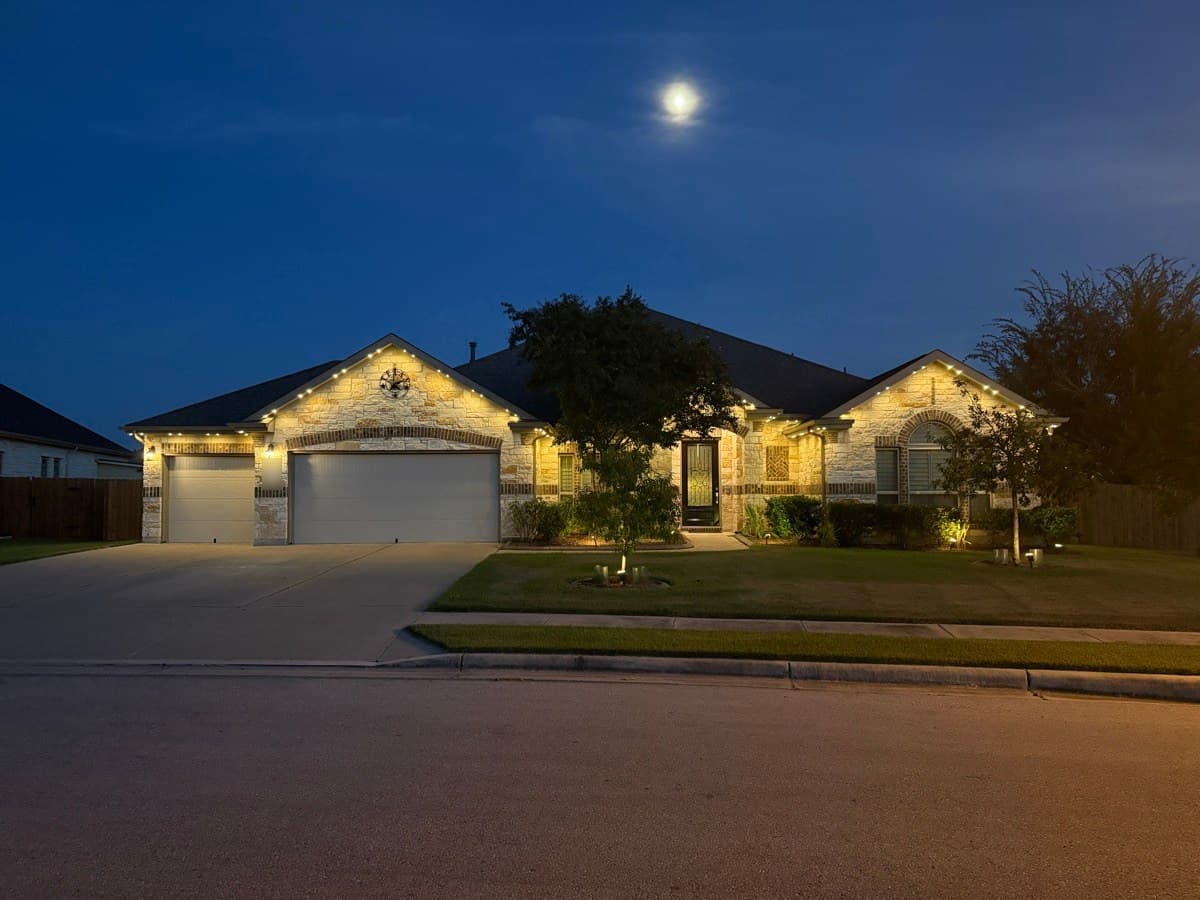
Austin Hill Country home with TruLight 48-volt permanent LED lighting along the entire roofline at night

Is 48-Volt Permanent Outdoor Lighting Safe? The Austin Engineering Breakdown

May 14, 2026 · By Tom Porter, Owner of TruLight Austin

If you have been shopping permanent outdoor lights in Austin, you may have run across a blog post warning homeowners about the "hidden cost" of 48-volt lighting systems. The post argues that 48-volt systems generate more heat in the wires, suffer more moisture damage, and wear out faster than 24-volt systems. It is a confident piece, written by a company that sells 24-volt, and you can read the original article here. We also recorded a video breakdown of voltage in permanent outdoor lighting that covers this article and the broader 5V, 12V, 24V, and 48V engineering trade-offs. Watch it on our voltage comparison page.

We are addressing it directly because TruLight is a 48-volt system, and the central engineering claim in that article is backwards. In a permanent outdoor lighting system, higher voltage means less heat in the wire, not more. The post also overstates the safety story and quotes a lifespan number that no LED in this category has been on the market long enough to prove.

Here is what is actually happening inside the wire, and why we chose 48 volts for the long rooflines and Texas climate of Austin homes.

Austin Hill Country home with TruLight 48-volt permanent LED lighting along the entire roofline at night

What Does the Competitor Blog Actually Claim About 48-Volt Systems?

The article makes three central claims about 48-volt permanent lighting:

  1. "There is a lot of power running through the wires, which creates a lot of heat" in a 48-volt system.
  2. That heat causes "expansion and contraction" cycles which crack the fixtures and let moisture in.
  3. The result is a shorter lifespan and "costly repairs or even a full replacement."

The post then claims its own 24-volt system runs cooler, lasts up to 40 years, and is safer "with less power and heat."

Each of these claims is either wrong or carefully misleading. Let us take them one at a time, starting with the headline argument: that 48-volt wiring is hotter than 24-volt wiring.

Why Higher Voltage Actually Means LESS Heat in the Wire

This is the part of the article that gets electrical engineering exactly backwards. To see why, you only need two formulas. They are the same two formulas the power industry has used for over a century.

The first is power. P = V × I. Power equals voltage times current.

The second is heat loss in a wire. Q = I² × R. Heat dissipated in a wire equals the current squared times the resistance.

Notice that heat in the wire depends on current, not voltage. And for a given amount of power delivered, current goes DOWN as voltage goes UP. Doubling the voltage from 24 volts to 48 volts cuts the current in half. Halving the current cuts the wire heat by 75 percent, because the loss equation squares the current.

This is not a TruLight argument. It is the same reason the entire North American power grid transmits electricity at hundreds of thousands of volts before stepping it down at the substation near your house. Higher voltage transmission has less heat loss in the wire over distance. The same principle applies in a permanent outdoor lighting system at much smaller scale.

Vicor, a major power-electronics manufacturer, puts the math directly in their published technical literature: "By increasing the bus voltage to 48V you can cut your distribution losses up to 75%, which dramatically reduces heat generation." That is the industry consensus on 48-volt LED systems, and it is one reason commercial LED installations have been moving toward 48-volt as standard.

So when the competitor blog post says a 48-volt system has "a lot of power running through the wires, which creates a lot of heat," it has cause and effect reversed. A 48-volt system at the same brightness has less current in the wires, which means less heat in the wires, which means less expansion and contraction at the connections, which means LESS chance of micro-cracks forming over time, not more.

If anything, the wire-heat argument cuts in the opposite direction from how the article framed it. The 48-volt system is the one that runs cooler in the cable. The 24-volt system has twice the current pushing through the wire to deliver the same brightness.

That is also why TruLight uses 16-gauge wire while most 12-volt and 24-volt permanent lighting systems use thinner 18-gauge. Lower current at higher voltage gives us room for a thicker, more durable conductor without needing to compensate for distribution loss.

Limestone Austin home with TruLight 48-volt permanent lighting at dusk

What About Heat in the LED Fixture Itself?

This is a fair follow-up. Wire heat is one thing. What about the LED chip in the fixture? Especially in a climate that can hit 105 degrees in the shade by July.

Here is where it helps to know how LEDs are actually driven. An LED is a current-driven device, not a voltage-driven one. Inside every fixture is a driver chip that regulates exactly how much current reaches the diode regardless of the bus voltage feeding it. Whether your system bus is 12 volts, 24 volts, or 48 volts, the LED chip itself sees the same designed current and runs at the same junction temperature.

In other words, the chip in a 48-volt fixture is not running hotter than the chip in a 24-volt fixture. Both are running at whatever current the driver was designed to deliver. If anything, a well-designed 48-volt fixture has MORE thermal headroom because the wire feeding it dissipates less heat upstream of the driver. In a Texas summer, that thermal headroom is real value.

The "expansion and contraction" story in the competitor article hinges on the assumption that 48-volt fixtures cycle hotter than 24-volt fixtures. That assumption is not grounded in the physics. Fixture heat depends on chip design, driver design, and heatsinking, not on the system bus voltage.

What actually matters for fixture longevity is sealing quality, driver quality, solder joint integrity, and how the gaskets handle UV and heat exposure. Those are real factors for Central Texas. None of them are determined by whether the system runs at 24 or 48 volts.

What LED Chip Is Actually Inside a 48-Volt TruLight Fixture?

This is where the voltage choice and the chip choice were designed to go together. The chip TruLight uses is the UCS7604, a 4-in-1 RGBW chip with 16-bit color depth (65,536 grayscale levels per channel) and a dedicated warm white LED built into the chip itself. TruLight fixtures carry 6 full LEDs per node: 3 RGB plus 3 dedicated warm white. The published manufacturer L70 rating is 100,000 hours.

This is where you have to read competitor specs carefully. Several 24-volt and 12-volt brands market their fixtures as "RGBW" or "with dedicated white," but the actual chip inside is a WS2811 or a WS2811-family variant with a small quarter-light yellow LED added to the node. That is not the same hardware as a true 4-in-1 RGBW chip with full-size warm white LEDs. A quarter-light yellow add-on can market a "white" option. It cannot produce the same warm white tone, the same true pure white from blending all channels at full output, or the same color rendering on Hill Country limestone and stucco that 3 full dedicated warm white LEDs deliver.

The WS2811 itself is an 8-bit RGB-only chip (256 levels per channel) originally designed for 5-volt and 12-volt systems. Its published rating is 50,000 hours. Some manufacturers use newer revisions or binned variants of the WS2811 family to claim longer chip life, but the underlying RGB-only architecture is the same generation of hardware. A revised WS2811 with a quarter-light yellow LED bolted on is not the same component as a UCS7604 with 3 dedicated warm white LEDs per node.

The UCS7604 has another feature that matters for an outdoor system in Texas. Signal redundancy. If one fixture in a TruLight run fails, the chip reroutes the signal around it and the rest of the line keeps working. On a WS2811-family system, one failed fixture stops the signal at that point, and every fixture downstream goes dark until a tech can get up there to swap it.

The honest test, if you are comparing two brands: ask each installer for the LED chip part number, the per-node LED count, and specifically how many of those LEDs are dedicated warm white versus RGB. A confident answer with a public data sheet behind it tells you the company knows what they are selling. A vague answer, or "RGBW" without specifying whether the warm white is a full dedicated LED or a small add-on, tells you something else.

The 48-volt bus on a TruLight fixture is paired with a chip that was designed for the higher-voltage RGBW generation. That pairing is the engineering reason the system supports long roofline runs with one injection point, true warm white from 3 dedicated warm white LEDs per node, and signal redundancy when an individual fixture fails.

Power Injection: How Many Boxes End Up On Your House?

Voltage controls how far a permanent lighting system can carry power before it needs another injection box. Every injection point is another box on your fascia, another set of wires through your soffit, and another connection that can fail. Here is what each voltage actually requires in real installs:

  • 5-volt systems: Power injection every 5 to 10 lights. Built for indoor strip lighting and small DIY projects, not residential rooflines.
  • 12-volt systems: Power injection every 20 to 40 lights. Common in older permanent lighting installs and budget brands.
  • 24-volt systems: Power injection every 50 to 100 lights. This is where most 24-volt brands, including the one whose blog post we are responding to, operate.
  • 48-volt systems (TruLight): Power injection every 400 or more lights. 90 percent of our installs use one injection box or less, because most homes are under 300 linear feet of roofline.

One of our dealers pulled out a previous install from a 12-volt competitor that had 15 power injection boxes on just the front of one home. 15 sets of wires running through the fascia. 15 extra fail points exposed to Texas heat and UV cycling. The same home on a TruLight 48-volt system needed zero injection boxes on the front.

Is 48 Volts Actually More Dangerous Than 24 Volts?

The other implication in the competitor article is that 48-volt systems carry more safety risk because they have "more power." This one is worth unpacking carefully because it is the claim most likely to worry a homeowner.

The National Electrical Code defines low-voltage lighting as systems operating at 30 volts AC or 60 volts DC or less. Both 24V DC and 48V DC fall well within that definition. Both qualify under NEC Article 411 for low-voltage lighting. Both are below the shock-hazard threshold the code uses to require additional protective measures.

In safety standards language, both 24V and 48V are SELV systems. SELV stands for Safety Extra-Low Voltage. The shock risk to humans and pets from a working low-voltage permanent lighting system is essentially zero at either voltage, assuming the install is done correctly and the system is not tampered with.

UL Class 2 power supply ratings, which is the category that permanent lighting transformers fall into, allow 48-volt output at up to 60 watts per circuit. Permanent lighting systems are required to use Class 2 supplies regardless of whether they run at 24 or 48 volts. The safety envelope is the same for both.

The actual safety differential between a 24V and 48V permanent lighting system on your home is negligible. Both are far below household current at 120V. Both have to meet the same Class 2 standards. Both have ground-fault protection in the supply. If a competitor is selling 24-volt by framing 48-volt as a safety hazard, that is a marketing position, not an engineering one.

Can a Permanent Outdoor Lighting System Really Last 40 Years?

The competitor article claims their 24-volt permanent lights "have a life expectancy of up to 40 years." Their main site backs that up with a 100,000-hour diode rating. Let us walk through what those numbers actually mean before you build a buying decision on them.

LED chips in this category are rated to L70, which is the point at which they retain 70 percent of original brightness. Premium permanent lighting chips, including the UCS7604 that TruLight uses and several similar RGBW chips on the market, are rated at 100,000 hours. At 7 hours per night of average runtime, that works out to about 39 years to L70. So 30 to 40 years is inside the math envelope for the diode itself, on paper.

There are three things the "40 years" claim is not telling you.

First, the 100,000-hour number is for the LED diode alone. It is not a rating for the full fixture. Drivers, solder joints, gaskets, connectors, and controllers typically fail well before the diode itself loses 30 percent of its brightness in real outdoor service. So the actual fixture lifespan is generally shorter than the chip rating, regardless of voltage. The chip rating is the upper bound, not the expected lifespan.

Second, permanent outdoor lighting as a consumer product category is not 40 years old. The first permanent residential systems shipped in the 2010s. No company in this category has 40 years of field data, because no fixture has been on a home for 40 years yet. A 40-year claim is extrapolated from a chip data sheet, not measured in the wild.

Third, "up to" is doing a lot of work in any 40-year claim. The 100,000-hour rating assumes ideal operating conditions, controlled current, and that nothing else in the fixture fails. Real outdoor service in Central Texas, with summer heat that hits 105 in the shade and the kind of UV that yellows plastic in a hurry, puts a ceiling on what any chip data sheet predicts.

That is why TruLight carries a lifetime transferable warranty rather than quote a year number. The warranty covers you regardless of what the chip data sheet predicts, and it is the only number that actually matters when something does fail.

What Actually Matters When You Are Comparing Permanent Lighting Systems

If voltage is not the safety story or the lifespan story, what should you be looking at when you compare brands in Austin?

SpecWhy It Matters
LED chipUCS7604 RGBW (6 LEDs per node) is the current top of the category. WS2811 RGB (3 LEDs per node) is older and RGB-only.
Real warm white channelA dedicated warm white LED flatters Hill Country limestone and stucco. RGB-only systems blend an off white that reads slightly blue or green.
Fixture build qualityAluminum track, sealed connections, real waterproofing, and a fixture that survives Texas UV and humidity without yellowing or cracking.
Wire gaugeThicker is better. 16-gauge handles long runs and high current loads. 18-gauge is thinner and runs hotter.
Warranty termsLifetime, transferable, and clearly covering the controller and wiring, not just the LEDs.
Power injection intervalFewer is cleaner. 48-volt systems run roughly 300 to 400 fixtures per injection point. 12-volt systems need a new injection every 50 to 70 fixtures.
App and motion patternsYou interact with the app every night for the life of the install. 144-plus patterns with density control and zoning beats 27 patterns with grouping only.

Voltage is one input into the picture. It is not the safety story it sometimes gets framed as, and it does not determine fixture lifespan on its own.

Want to see a 48-volt TruLight install on your specific Austin home?

Get Your Free Quote

Why TruLight Chose 48 Volts for Austin Homes

Austin home with TruLight 48-volt permanent lighting illuminating the long roofline at night

Austin homes have specific install conditions that make the voltage choice matter beyond pure theory. Drive through West Lake Hills, Lakeway, or Barton Creek in the evening and look at the roofline footage on those homes. Sprawling Hill Country limestone ranches. Two-story stucco with long, complex elevations. Single-story builds in Circle C Ranch and Dripping Springs that stretch 60 or 80 feet of continuous fascia across the front. These are exactly the homes where 12-volt and 24-volt systems start needing multiple power injection points on a single run.

A 48-volt system handles those long runs on a single injection point we tuck out of sight near the controller. The lower current in the wire means less heat at each connection, which matters in Texas summers when the fascia can sit at 130 degrees in the sun. The thicker 16-gauge wire we use has the margin to handle that environment for decades.

For a homeowner who wants the cleanest possible install with the fewest visible boxes on the fascia, 48 volts is the right engineering call for Austin. That is not a sales pitch. It is the choice you would make if you were designing a permanent lighting system from scratch for this climate and these rooflines.

If you would like to see what a 48-volt install actually looks like on your specific home, we will come walk it with you. We will show you where the controller goes, where the power injection lands, and why the wire-heat math actually works in your favor in Central Texas.

Frequently Asked Questions

Is a 48-volt permanent lighting system dangerous for kids or pets?

No. Both 24-volt and 48-volt permanent lighting systems are classified as SELV (Safety Extra-Low Voltage) under NEC Article 411. Both run below the 60V DC shock-hazard threshold and both use UL Class 2 power supplies. The shock risk from a working system is essentially zero at either voltage. Marketing that frames 48-volt as a safety risk is a positioning play, not an engineering reality.

Does a 48-volt system actually run hotter than a 24-volt system?

No. Wire heat is determined by current, not voltage, and 48-volt systems carry half the current of 24-volt systems at the same brightness. Power-electronics manufacturers like Vicor publish that 48-volt LED distribution can reduce wire-heat losses by up to 75 percent compared to lower-voltage systems. The "more heat" claim in some 24-volt marketing copy inverts the actual physics.

Can a permanent outdoor lighting system really last 40 years in Texas?

The L70 rating on premium LED chips like the UCS7604 is 100,000 hours, which is roughly 39 years at 7 hours per night. The diode itself is in the math envelope. But the 100,000-hour number is for the LED chip alone, not the full fixture. Drivers, gaskets, solder joints, and connectors typically fail sooner, and Texas heat plus UV exposure accelerates that wear. The permanent lighting product category also is not 40 years old, so no 40-year lifespan claim from any company has been field-tested across a full lifecycle. We carry a lifetime transferable warranty rather than quote a year number.

Why does TruLight use 48 volts instead of 12 or 24?

Three reasons. First, lower current in the wire means less heat loss and a cleaner install with fewer power injection points, which matters a lot on Hill Country homes with long rooflines. Second, 48-volt fixtures pair well with the UCS7604 RGBW chip and 6-LED-per-node design that produces real warm white on limestone and stucco. Third, the lower wire current lets us run thicker 16-gauge cable for better long-term durability through Texas heat cycles. For a long roofline in West Lake Hills or Circle C Ranch, the difference is one clean run versus three or four boxes on the fascia.

What LED chip does TruLight use and why does it matter?

TruLight uses the UCS7604, a 4-in-1 RGBW chip with 16-bit color depth and 3 dedicated warm white LEDs per node (6 full LEDs per node total). Many other systems market themselves as "RGBW" but actually use a WS2811-family chip with a small quarter-light yellow LED added to the node, which is not the same hardware as a true 4-in-1 RGBW chip with full-size warm white LEDs. The honest way to compare brands is to ask each installer for the chip part number, the per-node LED count, and specifically how many of those LEDs are dedicated warm white versus RGB.

Will I be able to tell the difference between a 24V and a 48V install on my house?

Yes, but not in the ways the competitor article suggests. The visible difference is the number of power injection boxes on your fascia. The functional difference is brightness consistency along long rooflines, since voltage drop is much smaller per fixture on a 48V run. The safety and lifespan differences are not where the real-world delta sits.

Ready to compare a 48-volt TruLight install to anything else you have quoted?

Request a Free Quote

Related Articles

If you have read the competitor article we linked at the top and have follow-up questions, we are glad to answer them. The engineering matters, the install matters, and the warranty matters. Voltage by itself is not a safety story, and a confident-sounding blog post does not change the physics of how current and heat actually work. Call TruLight Austin at (512) 812-8266 or request a free quote online. We will walk your home, show you what a 48-volt install looks like in real life, and let the numbers speak for themselves. For the full video walking through voltage tiers, the physics, and what lumens marketing leaves out, see our voltage comparison page.

Ready to Light Up Your Home?

Use our light preview tool to see your home in warm white, holiday colors, and more. Then get your free instant quote.

Get Your Free Quote Instantly