
RGB vs. RGBW Permanent Outdoor Lighting: Which Is Better for Austin Homes?
If you've been researching permanent outdoor lighting for your Austin home, you've probably run into two acronyms that look almost identical: RGB and RGBW. One extra letter. How much difference could it really make?
Quite a lot, actually. And for homeowners in West Lake Hills, Lakeway, Barton Creek, and across the Central Texas Hill Country, that single letter is often the difference between a lighting system that looks great on a screen and one that looks great on your house. The difference is inside the node, and it matters most when you use the lights for everyday warm white.
A Quick Primer: What RGB and RGBW Actually Mean
RGB stands for Red, Green, Blue. These are the three primary colors of light. By mixing them at different intensities, an RGB system can produce millions of color combinations. Want deep purple for a Halloween display? Done. Longhorns burnt orange for game day? No problem. A vivid green for St. Patrick's Day? Easy.
RGBW adds a fourth element: a dedicated warm white LED. In TruLight's system, each node contains 6 individual LEDs. Three are RGB (one red, one green, one blue) and three are dedicated warm white LEDs. That is not a small spec difference. It changes what the light can actually do.
The distinction matters most when you think about how you'll actually use permanent lighting day to day. Color displays are fun. They're great for holidays, parties, game days, and seasonal celebrations. But ask anyone who's had permanent lighting for more than a few months and they'll tell you the same thing: Most homeowners end up using warm white as their everyday setting. It's what makes your home look polished on a random Tuesday evening when you're pulling into the driveway.
And warm white is exactly where RGB systems fall short.
The White Light Problem That Nobody Talks About in the Sales Pitch
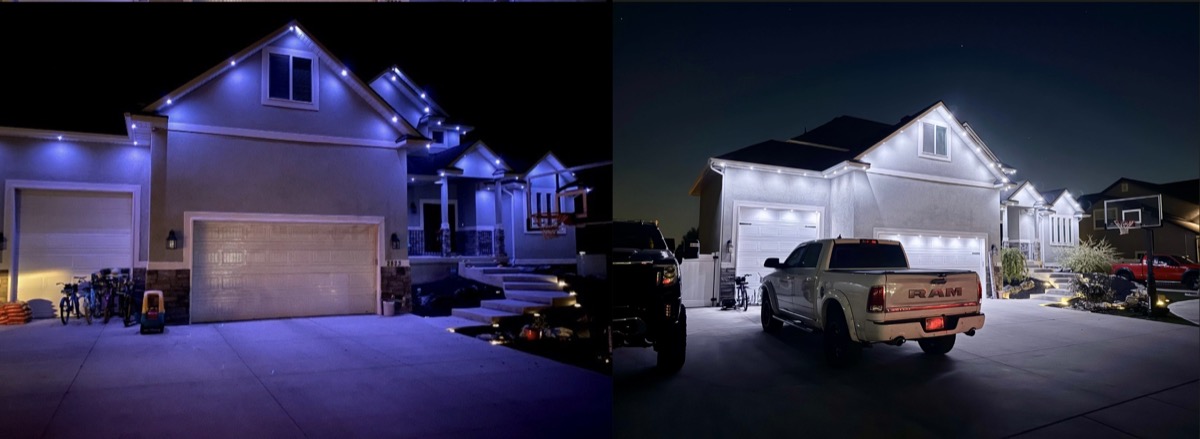
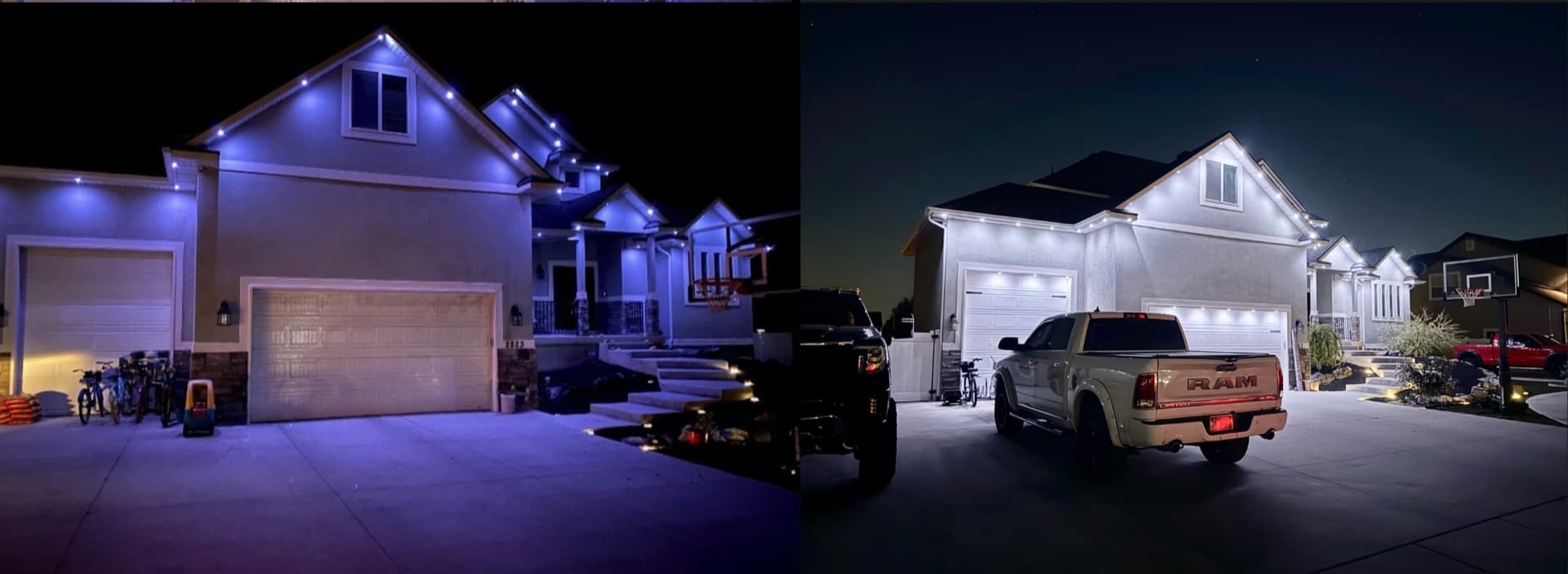
Here's the thing about RGB systems that most companies won't volunteer during the sales process: RGB can't produce true white light. It can produce something that looks white-ish by firing all three color LEDs at full intensity. But that mixed "white" carries a noticeable blue or purple tint. On a product demo screen inside your kitchen, it might look fine. On your house at night, standing in the driveway? The tint is unmistakable.
This happens because of how light physics works. Mixing red, green, and blue light together creates an approximation of white, not actual white. The color rendering is off. The warmth is missing. And depending on the surface it's hitting, the effect can range from "slightly cool" to "my house looks like a hospital parking garage."
RGBW systems solve this entirely by using dedicated warm white LEDs that produce genuine warm white light from a purpose-built chip. No mixing. No approximation. No blue tint. TruLight's 3+3 configuration takes it a step further: run the three warm white LEDs alone and you get beautiful, rich warm white. Turn all six on together, blending warm white with the RGB set, and you get a true pure white that no RGB-only system can replicate. That gives you two distinct white modes for different moods and occasions, plus the full color spectrum for everything else.
Why This Matters More on Austin Homes Than Anywhere Else
Austin's architectural palette is built on warm tones. Hill Country limestone. Cream and buff-colored stucco. Natural stone facades with amber and honey undertones. Texas ranch-style wood accents. These materials have character and warmth baked right into them.
When you put a blue-tinted RGB "white" on a warm limestone exterior, the light fights the stone. The natural warmth of the material gets washed out. The house looks cold, slightly off. You might not be able to articulate exactly what's wrong, but something feels sterile about the whole picture.
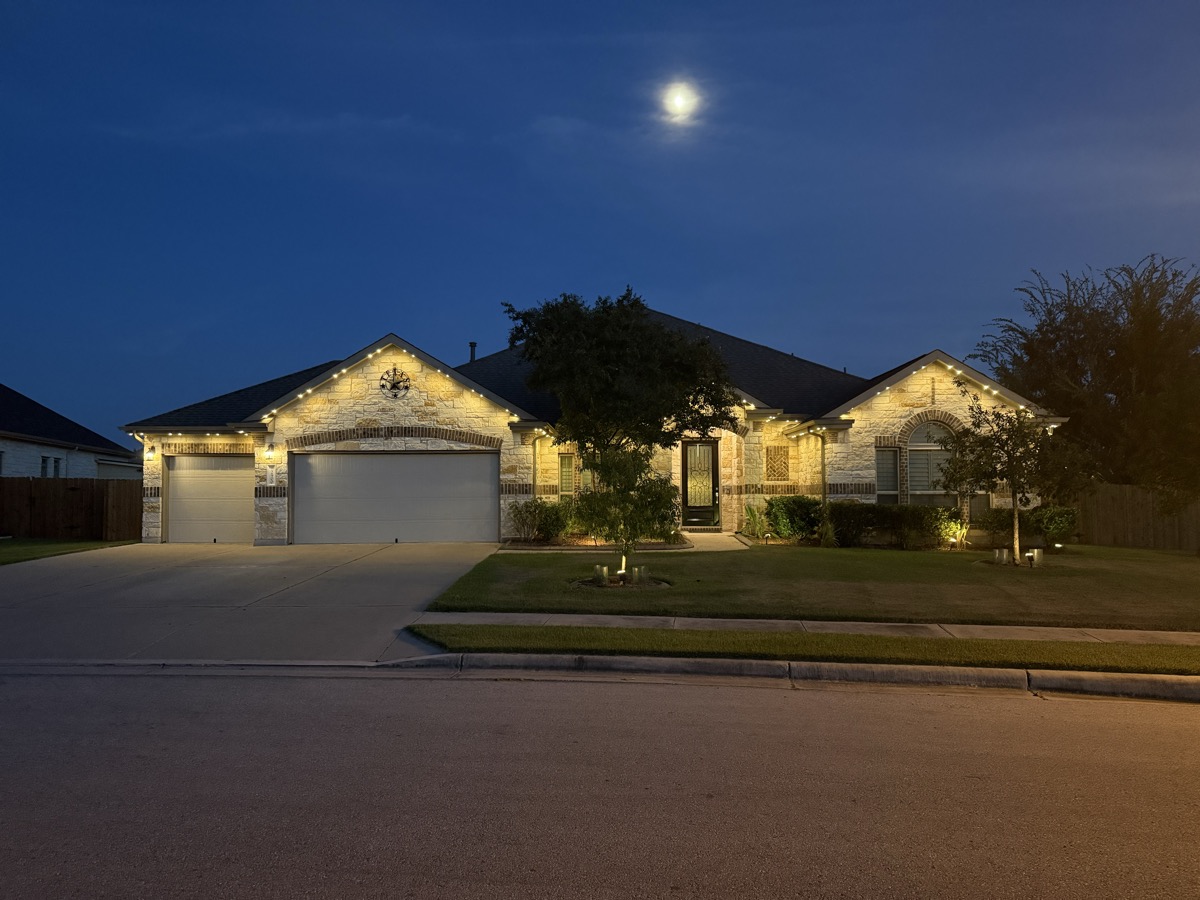
True warm white from an RGBW system does the opposite. It complements the stone. It brings out the natural texture and color variation in the limestone. The house glows the way Hill Country homes are supposed to glow after sunset. Walk through any well-lit neighborhood in Barton Creek or Dripping Springs at dusk and you'll see what this looks like in practice. The homes with warm, clean light along the roofline look like they belong there. The ones with cool or blue-tinted light look like they're trying too hard.
This isn't an abstract aesthetic debate. Drive through West Lake Hills on any evening and compare. The difference between warm white and blue-tinted white on a limestone facade is visible from the street, and it's the kind of detail that shapes first impressions whether you're hosting a neighborhood gathering or eventually listing the home.
6 LEDs Per Node: What the Brightness Difference Actually Looks Like
Many lower-cost permanent lighting systems use 1 or 3 LEDs per node. TruLight runs six. Three RGB LEDs plus three dedicated warm white LEDs in every single node across your entire roofline. The math on brightness isn't complicated: With 6 LEDs per node, TruLight has more emitters working in each light than 1-LED or 3-LED systems, which gives it noticeably stronger output.
Why does brightness matter beyond just looking impressive? In Central Texas, it's practical. Austin summers mean long evenings outdoors on the patio or back porch, and a well-lit perimeter provides real security value. Bright, consistent lighting along the roofline and eaves eliminates the dark pockets around your home that make properties more vulnerable. Motion sensor integration (which TruLight's system supports) takes this further, but the baseline brightness of a 6-LED node means even the standard warm white setting delivers genuine functional illumination, not just a decorative glow.
Brightness also affects how the system performs in Austin's variable weather. A system that looks sharp on a clear, dry evening in October needs to still perform on a humid August night or a foggy Hill Country morning after a spring thunderstorm. Higher output from more LEDs per node means the system maintains visual impact in conditions that would make a dimmer system look washed out.
48V vs 12V: The Voltage Question That Matters on Bigger Homes
This is a technical detail that most homeowners don't think to ask about, but it has real consequences for how the system performs, especially on the larger homes found in Lakeway, West Lake Hills, and Barton Creek.
Most affordable permanent lighting systems run on 12 volts. That works fine on a small home with a short roofline. But 12V can only push power so far. On a 3,500+ square-foot home with a long roofline, a 12V system needs additional power injection points to keep brightness consistent, extra wiring runs back to the controller or additional power supplies spaced along the roofline. Each injection point adds complexity, labor, and cost to the install. Without enough of them, one side of your house looks great while the other side fades.
TruLight runs a 48-volt system. That's four times the voltage of a standard 12V setup, which means the system can cover long rooflines from a single power source without the extra injection points that 12V systems require. For the larger Hill Country estates and ranch-style homes that are common across Austin's premium neighborhoods, this is the difference between a system that covers the whole home evenly and one that fades at the corners.
JellyFish, one of the other names you'll encounter in your research, also runs a 48V system, which is a point in their favor on the voltage front. But JellyFish uses an RGB-only configuration, which means you're back to the blue-tinted white problem described above. You get good voltage but compromised color quality on the setting you'll use most often.
Trimlight, another common name in Austin, runs on 12V with RGB-only LEDs. That's both the voltage limitation and the color limitation in the same system. On a modest-sized home, you might not notice either issue. On a 4,000-square-foot limestone home in Lakeway? Both issues become obvious.
Wondering what it would cost for your home? Get an instant estimate using our satellite tool. No visit required.
Get Your Free QuoteThe Real Cost Comparison: RGB vs RGBW Over Time
Let's talk about what everyone's actually wondering: what's the price difference?
An RGBW system with 6 LEDs per node does cost more upfront than an RGB system with fewer LEDs. That's real, and it would be dishonest to pretend otherwise. Depending on the size of the home and the complexity of the roofline, the premium for RGBW over RGB might run a few hundred to a couple thousand dollars on a typical Austin installation.
But the cost comparison changes dramatically when you stretch it across the lifespan of the system. TruLight's LEDs are rated for over 100,000 hours of operation. That's more than 34 years of nightly use. The system comes with a lifetime warranty: 100,000 hours for the lights, which is 11.4 years from installation, and five years for the control box. So the question isn't "what does it cost today?" The question is "what does it cost per year over the life of the system?"
When you frame it that way, the premium for RGBW over RGB works out to pennies per day. And you're getting that premium in the form of better light quality on the setting you'll use 80% of the time, double or triple the brightness, consistent performance on a long roofline, and two distinct white modes that no RGB system can match.
Compare that to seasonal holiday lights. Many Austin homeowners spend hundreds each year on seasonal installation and takedown for lights they never own and that come down in January, and larger homes can cost much more. A permanent RGBW system replaces that annual expense, handles holiday colors through the app, and adds real value to the home year-round.
What About App Control and Day-to-Day Use?
Both RGB and RGBW systems from most manufacturers come with app control these days, so that's largely a wash. Where TruLight's app experience pulls ahead is in the white light options. Because the system has dedicated warm white LEDs, you can set your everyday look to genuine warm white with a single tap. No fiddling with color sliders trying to find a "white" that doesn't look blue. No saving custom presets that approximate warmth but never quite get there.
Warm white is a dedicated mode, not a color mix. That simplicity matters because permanent lighting is something you interact with every day. If the everyday setting requires constant adjustment or compromise, the system becomes a mild annoyance instead of a background luxury. TruLight homeowners set their warm white once and leave it. When they want color for a specific event, they switch over, enjoy it, and switch back. The system is designed around how people actually use it, not around how demo videos look on Instagram.
Motion sensor integration adds another practical layer. TruLight's system supports motion-triggered lighting that can flash, brighten, or change color when movement is detected around the perimeter. It's an effective security feature that works cleanly because the hardware supports it natively, not as a bolted-on afterthought.
How to Evaluate What You're Actually Being Quoted
If you're comparing bids from different permanent lighting companies in Austin, here's a quick checklist of questions that will help you compare apples to apples:
How many LEDs per node? If the answer is 1 or 3, you're looking at a system that will produce significantly less light than a 6-LED node. This is the biggest driver of brightness difference between systems.
RGB or RGBW? If it's RGB only, ask to see the "white" setting on an actual home installation, not a product video. Look at it on a warm-toned surface like limestone or stucco. If it skews blue or purple, that's what it will look like on your home every night.
What voltage does the system run? If it's 12V and your home has more than about 150 linear feet of roofline, ask how many power injection points the install will need. More injection points mean more wiring, more penetrations, and higher installation cost. A 48V system covers the same distance with fewer power runs.
What's the warranty? TruLight offers a lifetime warranty: full replacement on the lights and control box for five years, then prorated coverage on the lights through year 11.4. Many competitors offer 2 to 5 years. On a system rated for 100,000+ hours, the warranty signals how much the manufacturer trusts their own hardware.
Can you see an installation on a similar home? Any reputable company should be happy to point you toward a local installation you can drive by in the evening. Ask TruLight Austin whether there is a nearby installation you can view in the evening.
The Bottom Line for Austin Homeowners
RGB permanent lighting systems work. They produce color, and they can look good on social media. If your primary interest is holiday displays and occasional color shows, an RGB system from a reputable installer will do that job.
But if you're investing in permanent lighting for your Austin home, and you plan to use it every night, it needs to look right on Hill Country limestone and natural stone. It also needs enough brightness to actually illuminate your property rather than just decorate it. For all of that, RGBW with 6 LEDs per node on a 48V system is the better investment. The upfront cost is slightly higher. The per-year cost over the life of the system is negligible. And the light quality on the setting you'll use most often is noticeably better.
Your home deserves lighting that complements what makes it beautiful, not lighting that fights it. For Austin's warm-toned, character-rich architecture, that means RGBW.
Frequently Asked Questions
Can I tell the difference between RGB white and RGBW white from the street?
Yes, and most people can without knowing anything about lighting technology. RGB white has a visible blue or purple cast, especially on warm-toned surfaces like limestone and stucco. RGBW warm white looks natural and clean. The easiest way to see it for yourself is to visit two different installations at night. TruLight Austin can point you to local homes in your area for comparison.
Is RGBW brighter than RGB?
In TruLight's case, yes, significantly. TruLight's RGBW nodes run 6 LEDs each (3 RGB + 3 warm white), compared to the 1 or 3 LEDs per node that most RGB systems use. That translates to 2 to 3 times more light output per node. The brightness difference is immediately noticeable, especially on larger homes where coverage matters.
Will a 12V system work on my home?
It depends on the size of your roofline. On a smaller home with a short run, 12V can perform adequately. On the larger homes common in Lakeway, West Lake Hills, and Barton Creek, a 12V system needs multiple power injection points to keep brightness consistent across the full roofline, which adds complexity and cost to the install. TruLight's 48V system covers long runs from a single power source, keeping brightness even across the full perimeter with a cleaner installation.
How long does an RGBW permanent lighting installation take?
TruLight Austin typically completes installations in a single day. The hardware mounts flush to the roofline and is virtually invisible during daylight hours. There's no visible wiring, no bulky fixtures, and no damage to the fascia or eaves.
What's the lifespan of TruLight's RGBW system?
The LEDs are rated for over 100,000 hours of operation. Running the system every evening, that works out to more than 34 years. The system is backed by a lifetime warranty that covers the lights through year 11.4 and the control box for five years. Read the written terms for what it covers and for how long.
Related Articles
See What RGBW Looks Like on Your Austin Home
TruLight Austin installs permanent RGBW lighting for homeowners throughout Central Texas, including West Lake Hills, Lakeway, Circle C, Barton Creek, Dripping Springs, Georgetown, Cedar Park, Kyle, and Buda. Most installations are completed in a single day, backed by a lifetime warranty, and designed around your home's specific architecture.
Want to see the difference between RGB and RGBW in person? We're happy to point you to local installations in your neighborhood so you can judge the light quality for yourself before making a decision. Schedule your free consultation and let's talk about what your home could look like.
Ready to Light Up Your Home?
Use our light preview tool to see your home in warm white, holiday colors, and more. Then get your free instant quote.
Get Your Free Quote Instantly