5-Year Cost Guide: Permanent vs Seasonal Holiday Lights in Austin
Every November, the same routine plays out across Central Texas. It's 75 degrees on Saturday and 45 by Sunday night. You've got tangled light strands in a bin that's been sitting in the garage since last January. Half the bulbs are dead. The ladder is leaning against the house, and you're three hours into what was supposed to be a quick afternoon project. Meanwhile, your neighbor across the street just tapped an app and their entire roofline lit up in warm white.
We've installed permanent lighting on hundreds of homes from West Lake Hills to Georgetown, and the conversation almost always starts the same way: "I just want to know if it's actually cheaper in the long run." Honest question. So we sat down and built out the real numbers, year by year, for a typical Austin-area home. Not vague estimates or national averages. Actual costs you can check against your own receipts and your Austin Energy bill.
What Most Austin Homeowners Actually Spend on Seasonal Lights
People underestimate this number every single year. It's not just the lights. It's everything that comes with them.
Here's what a typical Austin homeowner spends annually on seasonal holiday lighting:
- Light strings and replacement bulbs: $75-$150. Texas heat does a number on stored lights. That garage in July hit 130+ degrees, and cheap LED strands don't survive it. Even if you reuse most of last year's sets, there's always a dead section or two.
- Clips, hooks, extension cords, timers: $30-$60. Something always goes missing, melts, or gets tossed when you can't find the box.
- Professional installation and removal: $400-$1,200. Demand in the Austin market spikes hard in late October and November. A two-story home in Barton Creek or a stone-front in Lakeway will be on the higher end. Single-story ranch homes in Cedar Park or Circle C come in lower, but you're still writing a big check every year.
- Electricity: $25-$70 for the season depending on what you're running. Incandescent C9s on a 100-foot roofline will cost significantly more than a basic LED strand setup, especially at Austin Energy's current rates of $0.11-$0.13 per kWh.
- Your time: Hard to put a dollar figure on, but most DIY setups eat 6-10 hours of a weekend. That's an entire Saturday morning you could've spent at Zilker, or not spent on a ladder.
Add it all up, and the homeowner who does their own lights is spending $200-$400 per year (plus the time). The homeowner who hires a seasonal service is spending $600-$1,200. And that's before anything breaks or melts in storage over the summer.
The Year-by-Year Breakdown: 5 Seasons Side by Side
This is the comparison most websites skip. They tell you permanent lights "pay for themselves" but never actually show the math. So here it is, year by year, for a typical Austin home with about 120-180 linear feet of roofline.
| Year | Seasonal (Professional) | Seasonal (DIY) | Permanent (TruLight) |
|---|---|---|---|
| 1 | $800 | $350 | $4,000 |
| 2 | $1,600 | $600 | $4,005 |
| 3 | $2,400 | $900 | $4,010 |
| 4 | $3,200 | $1,250 | $4,015 |
| 5 | $4,000 | $1,650 | $4,020 |
The numbers tell a clear story. If you hire a professional seasonal crew each year, a permanent system breaks even right around year five and starts saving you money from that point forward. Every year after that, you're only paying pennies in electricity while the seasonal homeowner keeps writing annual checks.
For the DIY crowd, the savings math takes longer. But the table also doesn't capture what DIY actually costs you: the hours, the frustration, the trips to Home Depot, the risk of being on a ladder, and the fact that Texas heat destroys whatever you store in the garage over summer. Those hidden costs close the gap faster than the numbers suggest.
Want to see what the numbers look like for your specific roofline? We can run the math for your home on a free quote call. No pressure, just the actual numbers.

The Hidden Costs Nobody Includes in the "Seasonal Is Cheaper" Argument
The table above tells the financial story. But there are costs that don't fit neatly into a spreadsheet, and they're worth talking about because they're real.
Storage Damage
This is an Austin-specific problem that people in cooler climates don't deal with. Your garage hits 130-140 degrees in July and August. That heat warps plastic connectors, degrades wiring insulation, and kills LED drivers. Light strands that worked perfectly in December have a coin-flip chance of surviving a Texas summer in the garage. So each November, you're testing, tossing, and replacing. That replacement cost adds up year after year and it's baked into the DIY numbers above, but most people don't realize how much they're spending until they add it all up.
Time Value
A conservative estimate is 6-10 hours per season for a DIY holiday light setup. That includes pulling everything out of storage, testing strands, going to the store for replacements, getting up on the ladder, running extension cords, and then doing it all in reverse in January. If your time is worth $50 an hour (and plenty of Austin homeowners would say it's worth more), that's $300-$500 in time every single year. The table doesn't count that, but your weekends do.
Safety Risk
The Consumer Product Safety Commission reports roughly 18,400 emergency room visits annually from holiday decorating accidents. About 5,800 involve falls, and 65% of those happen on ladders. A study looking at severe Christmas light installation injuries found patients were 95% male with an average age of 55. The fall-related morbidity rate was 28%. The mortality rate was 5%.
Five percent of severe ladder falls while hanging Christmas lights were fatal. That's a number worth sitting with.
In Austin, the risk factors are different from northern states but still real. Two-story homes are common across West Lake Hills, Barton Creek, and the newer communities in Dripping Springs. Texas rooflines can be steep and complex with multiple gable peaks. Morning dew on a tile or metal roof in November can make surfaces slick. And the afternoon sun makes you rush to finish before it gets dark, which is exactly when mistakes happen.
A permanent system gets installed once by a professional crew with proper equipment and insurance. After that, everything is controlled from an app on your phone. No more ladder days. No more reaching over the gutter to clip one more strand. That peace of mind doesn't show up in a cost comparison, but ask anyone who's had a scare on a ladder whether it matters.
Replacement Bulb Creep
Year one, you buy a full set of lights. Year two, you replace one strand. Year three, two strands. By year four, you've replaced nearly everything but you never bought a "new set" so it doesn't feel like a major expense. This gradual replacement is one of the sneakiest costs of seasonal lighting. It adds $50-$150 per year and it's easy to overlook because no single purchase feels big.
Why Permanent Systems Cost What They Do
Sticker shock is real. When someone hears "$4,000" they naturally compare it to a $40 box of lights from Home Depot. But those are completely different products solving completely different problems.
Here's what actually goes into a permanent installation on a typical Austin home:
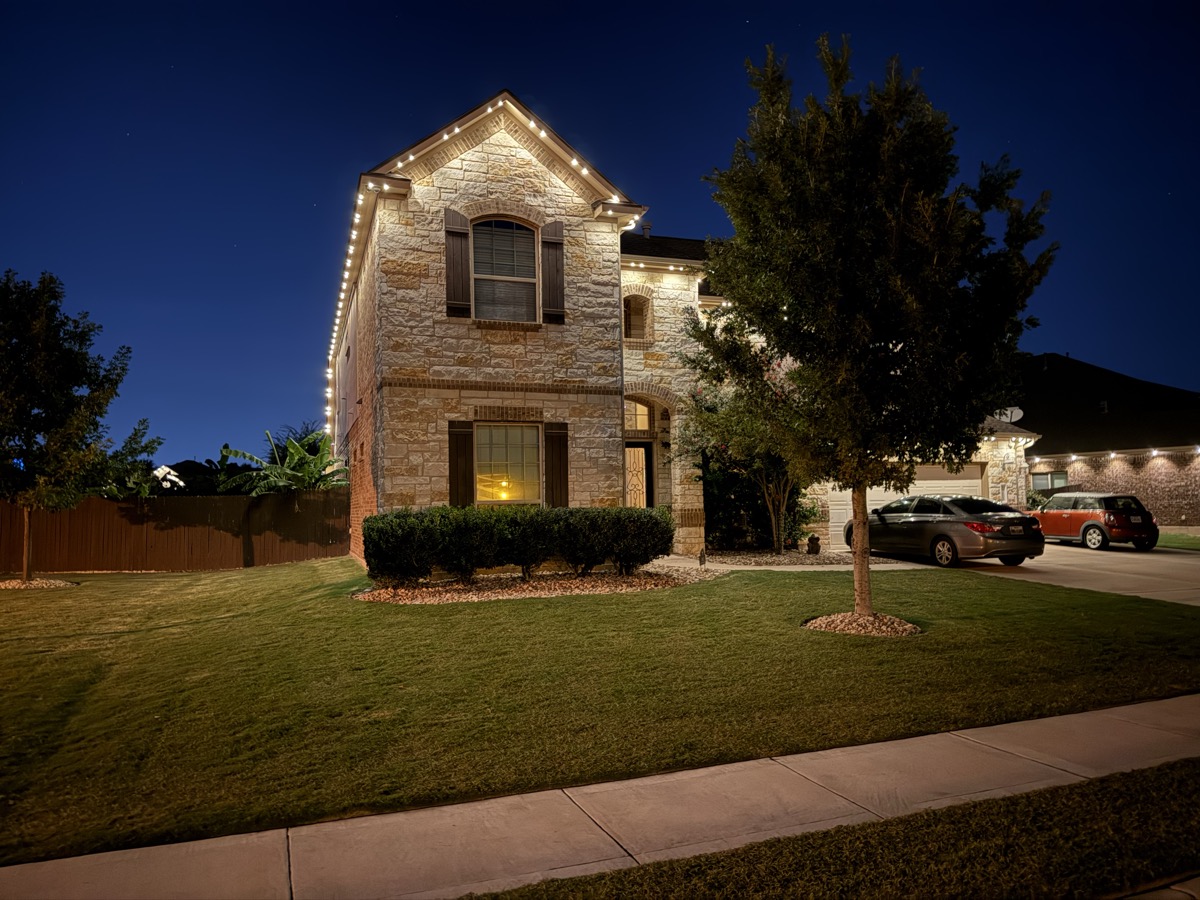
The hardware. TruLight Austin uses RGBW LEDs with 6 diodes per node: 3 RGB and 3 dedicated warm white. That dedicated white channel is why the warm white looks like actual warm light and not the bluish-purple tint you get from mixing RGB together. You're getting 2 to 3 times the brightness of standard permanent lighting systems, and each LED is rated for 100,000+ hours of operation. At 6 hours per night, that's over 45 years before you'd need to think about replacing anything.
The electrical architecture. The system runs on 48 volts. Most competitors use 12V or 24V systems. The higher voltage means less current draw for the same brightness, less heat buildup in the wiring, and more consistent output across long runs. For a home in Lakeway or Dripping Springs with 200+ feet of roofline, that consistency matters. A 12V system needs multiple power injection points on longer runs to keep brightness even, which adds hardware, labor, and cost to the install. A 48V system covers the same distance from a single power source.
Wondering what it would cost for your home? Get an instant estimate using our satellite tool. No visit required.
Get Your Free QuoteThe installation. This isn't someone zip-tying LED strips to your gutter. Every foot of track is custom-measured and color-matched to your fascia. On Austin limestone and stucco homes, the mounting has to be right or it looks wrong. The installation crew spends time getting the alignment clean so the track disappears during the day and only the light shows at night. That's the difference between "those people have strip lights on their roof" and "that house looks amazing."
The warranty. TruLight Austin's system comes with a lifetime transferable warranty. Not 3 years, not 5 years. Lifetime. And if you sell your home, the warranty transfers to the new owner at no cost. That's not a marketing line when the product is rated for over a decade of daily use.
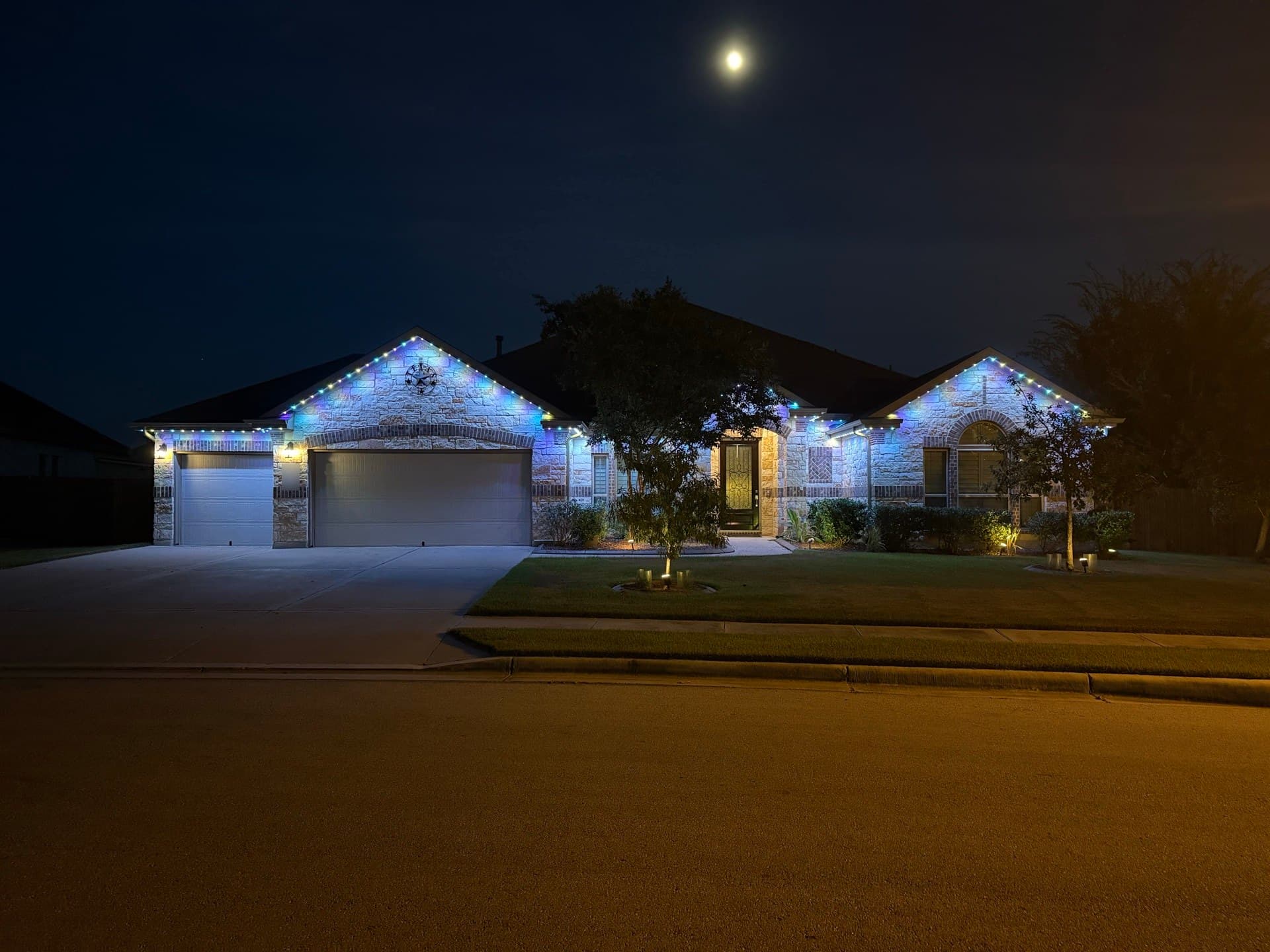
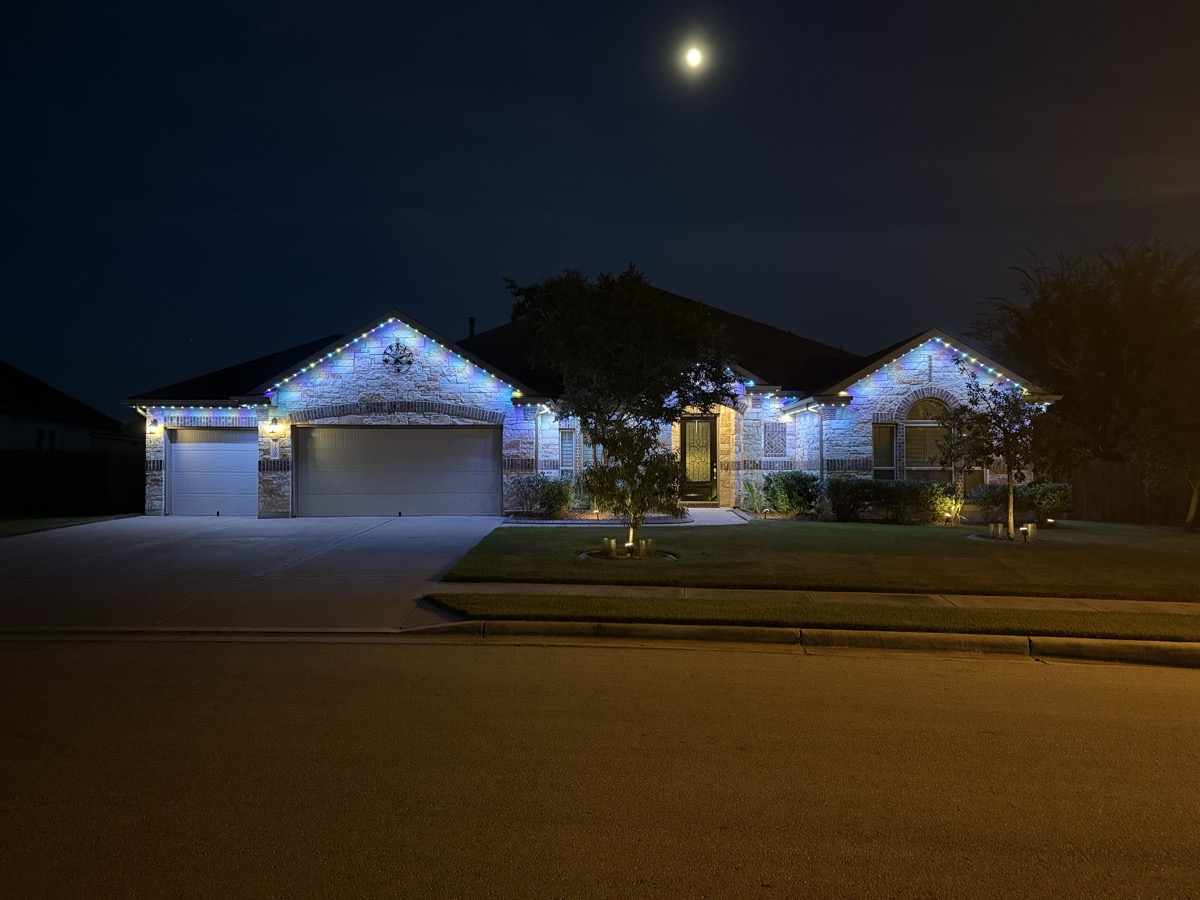
The controls. Full app control with motion sensor integration. Set schedules, change colors, trigger animations, or activate security lighting from anywhere. The system responds to motion sensors, so it can function as security lighting when you want it to. That's another layer of value that seasonal lights simply cannot provide.

The Energy Math at Austin Energy Rates
Austin Energy residential rates currently sit around $0.11-$0.13 per kWh, depending on your tier and usage. That makes the energy comparison between seasonal and permanent lighting pretty straightforward.
A typical permanent LED system running 150 nodes for 4-6 hours a night uses about 5-7 kWh per month. At Austin Energy rates, that's roughly $0.65 to $0.90 per month. Even if you run them every single night year-round, you're looking at about $5 per month. That works out to around $60 per year for a system you use 365 nights.
Now compare that to a seasonal incandescent setup. A standard C9 incandescent strand draws about 175 watts per 25-foot string. Four strings on a 100-foot roofline pull 700 watts. Running those 6 hours a night for 6 weeks burns through about 176 kWh. At $0.12 per kWh, that's $21 just for the roofline. Add bushes, trees, and yard features and you're easily at $35-$60 for the season.
The permanent system costs about $5 per month in electricity for year-round daily use. The seasonal incandescent setup costs $35-$60 for just six weeks. LED seasonal strings close the gap somewhat, but they still can't match the efficiency of a purpose-built 48V permanent system drawing power only when it's actually on.
And here's the thing about Austin Energy rates: they've been climbing. If rates increase another 10-15% over the next few years (which is the trend), the permanent system's energy advantage compounds. A system that costs almost nothing to run today will still cost almost nothing to run in five years. A seasonal incandescent setup? Not so much.
Beyond December: What You're Actually Paying For
The 5-year cost comparison above only counts holiday use. But a permanent system works 365 days a year. That completely changes what you're actually getting for your money.
Most of our Austin homeowners use their lights far more than they expected. Here's what a typical year looks like:
- January through March: Soft warm white for those shorter winter evenings. Austin winters are mild, which means more time on the patio. A lit roofline makes the whole house feel warmer and more inviting when you pull into the driveway at night.
- March and April: Wildflower season. Soft purple and blue accents for spring evenings when the bluebonnets are out.
- May and June: Graduation parties, end-of-school celebrations. Pick your school colors or go with something fun for the kids.
- July: Red, white, and blue for Independence Day. One tap on the app, and you're ready.
- September and October: Orange and purple for Halloween. Amber and warm tones for fall. Austin goes big for Halloween, and your house can be the best one on the block without a single extension cord.
- November and December: Full holiday mode. Classic warm white, multicolor, animated patterns, whatever fits your style. Switch from Thanksgiving gold to Christmas colors the next morning without touching a single light.
- Game days: Burnt orange for the Longhorns. Whatever your household cheers for, the lights can match.
- Birthdays, pool parties, backyard dinners: Pick a color, set it from the couch, done. Your outdoor space goes from dark to dialed-in in about three seconds.
When you factor in that kind of daily use, the cost-per-use of a permanent system drops to almost nothing. Seasonal lights give you six weeks. A permanent system gives you 365 nights. That's the math that really changes the conversation.
What About Resale Value?
Homeowners who might sell in the next few years sometimes hesitate on permanent lighting. Makes sense on the surface. Why invest in a house you might leave?
But here's what we're seeing in the Austin market. Permanent lighting is becoming a feature that buyers notice and realtors mention in listings. In neighborhoods like West Lake Hills, Barton Creek, Circle C, and the newer builds in Dripping Springs, where homes already have upgraded exteriors, permanent roofline lighting reads as a finished, high-end detail. It's in the same category as a well-designed landscape or hardscaped patio. Buyers see it and think "this house is taken care of."
Real estate sources consistently report that quality exterior lighting adds measurable curb appeal value. One widely cited figure puts it as high as 12% for homes with professional-grade landscape and architectural lighting. Even if permanent roofline lighting alone accounts for a fraction of that, you're still getting a solid return on the install cost at sale.
And here's the detail that really matters for the "but I might move" concern: TruLight Austin's lifetime warranty is transferable. When you sell, the warranty transfers to the new homeowner at no cost. That's a selling point you can put right in the listing, and it's one that stands out. The buyer isn't just getting a lighting system. They're getting a fully warrantied lighting system that they'll never need to replace.
If you're in one of the fast-growing communities in Cedar Park, Georgetown, or Dripping Springs where new construction means your home is competing with a dozen similar floor plans, permanent lighting is the kind of detail that separates yours from the rest of the street. We hear that from homeowners all the time. It's one of the first things people comment on.
Frequently Asked Questions
How much do permanent holiday lights cost in Austin?
For a typical Austin home with 120-180 linear feet of roofline, expect to invest between $3,000 and $5,000 for a professional permanent LED system. The exact price depends on your home's size, roofline complexity, the number of peaks and corners, and whether you want front-only or full-perimeter coverage. TruLight Austin offers free on-site quotes so you can get an exact number for your home.
Do permanent Christmas lights really save money over time?
Yes, especially if you're comparing against professional seasonal installation. A homeowner paying $800 per year for install, removal, and light replacements will break even with a permanent system around year 5. After that, the permanent system costs only electricity to operate, roughly $5 per month. By year 7 or 8, the savings are well over $1,000 compared to continuing with seasonal service. And that doesn't factor in the year-round value you get from the system outside of December.
How much electricity do permanent LED lights use on Austin Energy rates?
Very little. A 150-node RGBW system running 4-6 hours per night costs about $5 per month on Austin Energy's current residential rates. That's roughly $60 per year for year-round nightly use. Compare that to seasonal incandescent strands that can cost $35-$60 for just the six-week holiday season.
Will permanent lights work on my Austin limestone or stucco home?
Absolutely. The track is custom-cut and color-matched to your fascia, so it blends in during the day regardless of your exterior material. Austin limestone, stucco, fiber cement, wood, and hardie board all work. The RGBW system's dedicated warm white channel looks especially good on the warm stone tones common across Central Texas, producing genuine warm light instead of the blue-tinted white that standard RGB systems create.
What if I want to add lights to more areas later?
The system is expandable. If you start with the front roofline and later want to add the back of the house, garage lines, or other architectural features, we can extend the existing system. Everything runs through the same app and controller, so adding sections doesn't mean adding complexity.
Related Articles
We're biased. We install these systems for a living. But the math is right there in the table, and we showed you all of it. If you want to see what the numbers look like for your specific house, we do free quotes for homes anywhere in the greater Austin area, from Georgetown down to Dripping Springs. Grab a quote, compare it to what you spent last November, and go from there.
Ready to Light Up Your Home?
Use our light preview tool to see your home in warm white, holiday colors, and more. Then get your free instant quote.
Get Your Free Quote Instantly