TruLight vs Bosso: What Austin Homeowners Need to Know
I own the TruLight dealership here in Austin, which means I sell one of the two systems discussed below. Read this the way you would read anything written by a person with money riding on the answer. I am not going to tell you that the other company builds a bad product, because I have no basis for saying that and no test data of my own to show you. What I can do is lay out what each company publishes about itself, explain which of those claims change the result on an Austin home, and give you the questions I would ask if I were the one signing. The condensed version lives on our TruLight vs Bosso comparison page.
What each company publishes
Bosso
Bosso's homepage describes a professionally installed permanent lighting system with app control, zones, voice or AI commands, music synchronization, hundreds of preset patterns, 16 million colors, and integrations with Alexa, Google, Siri and Control4. Those are Bosso's own descriptions of Bosso's product, and they are the right starting point for a conversation with a Bosso dealer.
That page does not give me a system voltage or a warranty duration, so I am not going to guess at either one, and neither should any salesperson quoting the brand secondhand. If Bosso is on your short list, ask the local Bosso dealer for the current written warranty document and the electrical design drawn for your specific house. A homepage is marketing copy. A signed warranty and a real design are the things you can hold someone to two winters from now.
TruLight
Our system is 48 volt low voltage. Each RGBW node carries six LEDs: three RGB plus three dedicated warm white. The published light rating is 100,000 hours. The nodes sit inside a professionally installed, color matched aluminum track. Our current warranty terms are posted at /warranty, and if anything a rep tells you conflicts with that page, the page is what counts. Ask us for it in writing the same way you should ask everyone else.
The color count is the least useful number on either website
Sixteen million colors is what you get when you mix three channels at eight bits each. It is arithmetic rather than a differentiator, and Bosso states that figure on its homepage. Color-count claims stop being useful once both systems offer a broad palette.
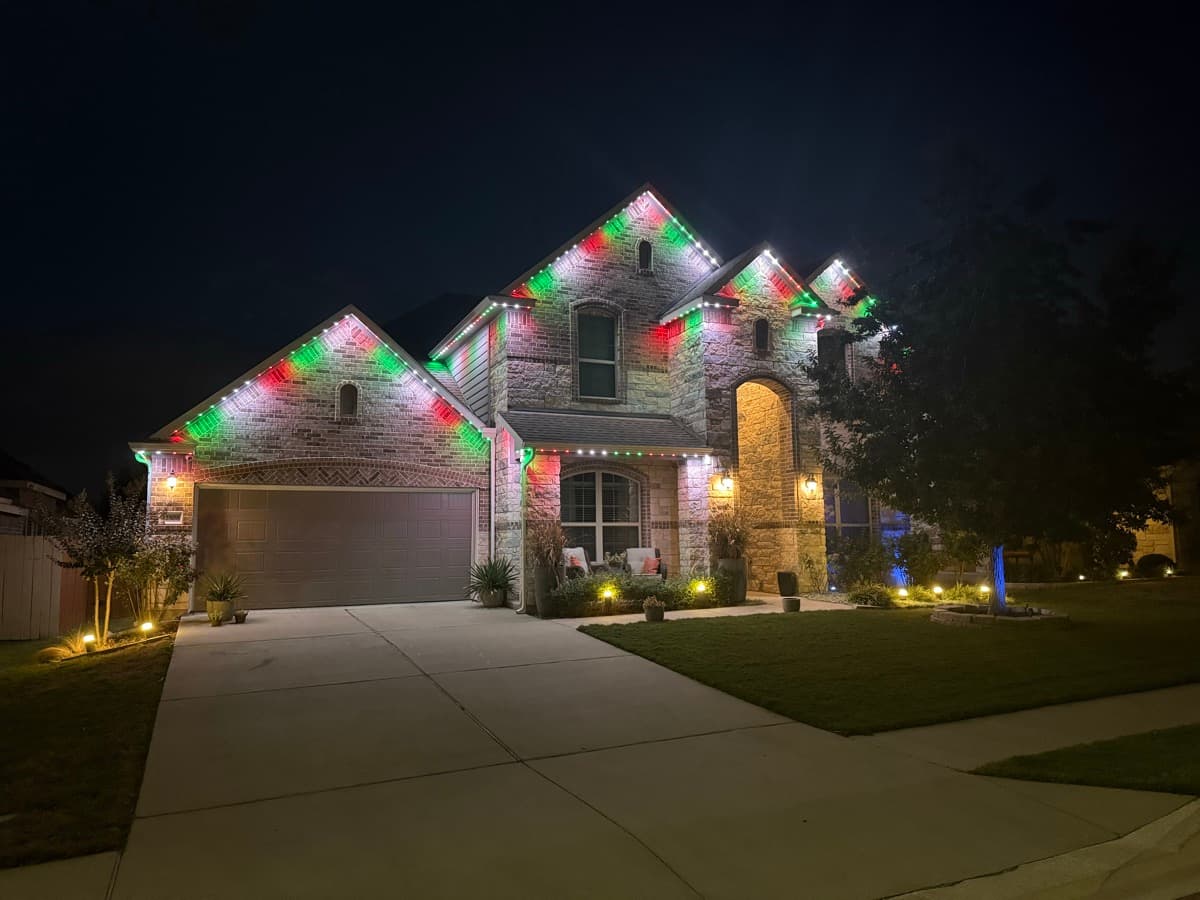
The number that does change what you see is how the system makes white. Holiday color runs for a few weeks. If warm architectural white is what you plan to run the rest of the year, that is the setting your neighbors and your resale photos will be looking at. A dedicated warm white diode produces white directly. White mixed from red, green and blue channels is a blend. Dedicated white and RGB-mixed white can look different, which is why the comparison worth making is between finished installations after dark.
Our nodes carry three dedicated warm white LEDs alongside the three RGB. The Bosso homepage I reviewed does not state how its fixtures produce white, so I will not characterize it. Ask the dealer directly: does the fixture contain dedicated white diodes, or is white mixed from the color channels? Then ask to see the answer demonstrated after dark on a house, not on a phone screen in your kitchen.
Long rooflines change the electrical conversation
On a large lot, a single front elevation can carry more linear feet than an entire house on a tighter one, and detached garages and long porch returns push the far end of a run further from its power source. Those distances, measured on your house, are what the electrical design has to answer to.
Distance is where permanent lighting installs get technical. Voltage drops across a run, and when it drops far enough, the far end of the run shifts in brightness and color against the near end. The fix is power injection, meaning additional feed points along the run. You may hear a salesperson claim that a higher voltage system automatically needs fewer injection points. Do not accept that as a rule. Run length depends on wire gauge, total load on the circuit, physical distance, the controller in use, and the manufacturer's own published limits. Those variables interact, and no single spec on a brochure settles it.
So make every bidder show you the design on paper.
- Where does each power supply live, and how many are in the plan?
- Where are the injection points, and why those locations?
- What is the longest single run on the house, and what is the manufacturer's stated maximum for that configuration?
- What happens electrically at the detached garage or the far end of the back elevation?
- Which parts of the plan are dictated by the manufacturer's limits and which are the installer's judgment?
Require written answers to those five questions on your specific roofline before you sign. App features are a separate conversation.
Sun, heat, and the part of the system that never turns off
Central Texas gives these systems a hard time, with long stretches of direct sun, high summer heat, and a lot of daylight hours where the lights are off and the housing is simply part of your architecture. On limestone and stucco elevations, that daytime read is worth as much of your attention as the night one.
Our track is color matched aluminum and installed professionally, which is the whole point of a permanent system as opposed to something clipped up in November. Bosso's homepage also describes professional permanent installation. What neither website can tell you is how a specific finish will look against your specific stone in five years, so put the question to both dealers in concrete terms: what material is the housing, what is the finish, how is the color matched to my fascia or my stone, and what does the written warranty say about finish, fade and corrosion as distinct from the LEDs themselves. Warranty language often treats those as separate categories, and the difference tends to surface exactly when you need it.
Side by side, with the gaps left as gaps
| Item | TruLight (published) | Bosso (per bosso.biz homepage) |
|---|---|---|
| System voltage | 48V low voltage | Not stated on the homepage; request in writing from the dealer |
| LEDs per node | Six per RGBW node: three RGB, three dedicated warm white | Not stated on the homepage; request in writing from the dealer |
| Published light rating | 100,000 hours | Not stated on the homepage; request in writing from the dealer |
| Housing | Professionally installed color matched aluminum track | Bosso describes professional permanent installation |
| Color range | RGBW mixing | Bosso states 16 million colors |
| Control and automation | App control with zones and scheduling; confirm current feature set with us directly | Bosso states app control, zones, voice or AI commands, music sync, hundreds of presets |
| Smart home integrations | Confirm current supported platforms with us directly | Bosso states Alexa, Google, Siri and Control4 |
| Warranty | Current terms at /warranty | No duration stated on the homepage; obtain current written terms from the dealer |
| Run and power design | Ask us for the drawing for your home | Ask the Bosso dealer for the drawing for your home |
The blanks in that third column describe what one public page contains, and nothing more than that. Fill them in with a written quote before you compare anything.
What I would do with two bids in hand
- Get both warranties as documents, not summaries, and read what is covered in year one versus year six, and whether labor is included.
- Get both electrical designs on paper for your address.
- See both systems lit on a real house after dark, on warm white, not just on a color show.
- Look at both tracks in daylight against material similar to your own.
- Ask who services the system in three years, and whether that is the manufacturer, the dealer, or a subcontractor.
- Ask what happens to app features and integrations if a platform changes, since software support is a moving target for every brand in this category.
If both bids survive that, you have two good options and you can decide on price, finish and the people you would rather have on your roof. I would rather you get there on your own reading than on my say-so.
Sources
- Bosso homepage (bosso.biz), reviewed August 10, 2026, for statements about professional permanent installation, app control, zones, voice or AI commands, music synchronization, preset patterns, 16 million colors, and Alexa, Google, Siri and Control4 integrations.
- TruLight warranty terms for current TruLight coverage.
- TruLight permanent lighting service details.
Specifications and warranty terms change without notice on every brand's website, including ours. Confirm current written specs and warranty with the local dealer before you sign anything.
Related articles
Get a design for your roofline
If you want to see what a run and power plan looks like on your house before you compare it to anyone else's, request an estimate and we will put the design in writing. Use it to ask every bidder for the same level of detail.
Ready to Light Up Your Home?
Use our light preview tool to see your home in warm white, holiday colors, and more. Then get your free instant quote.
Get Your Free Quote Instantly