
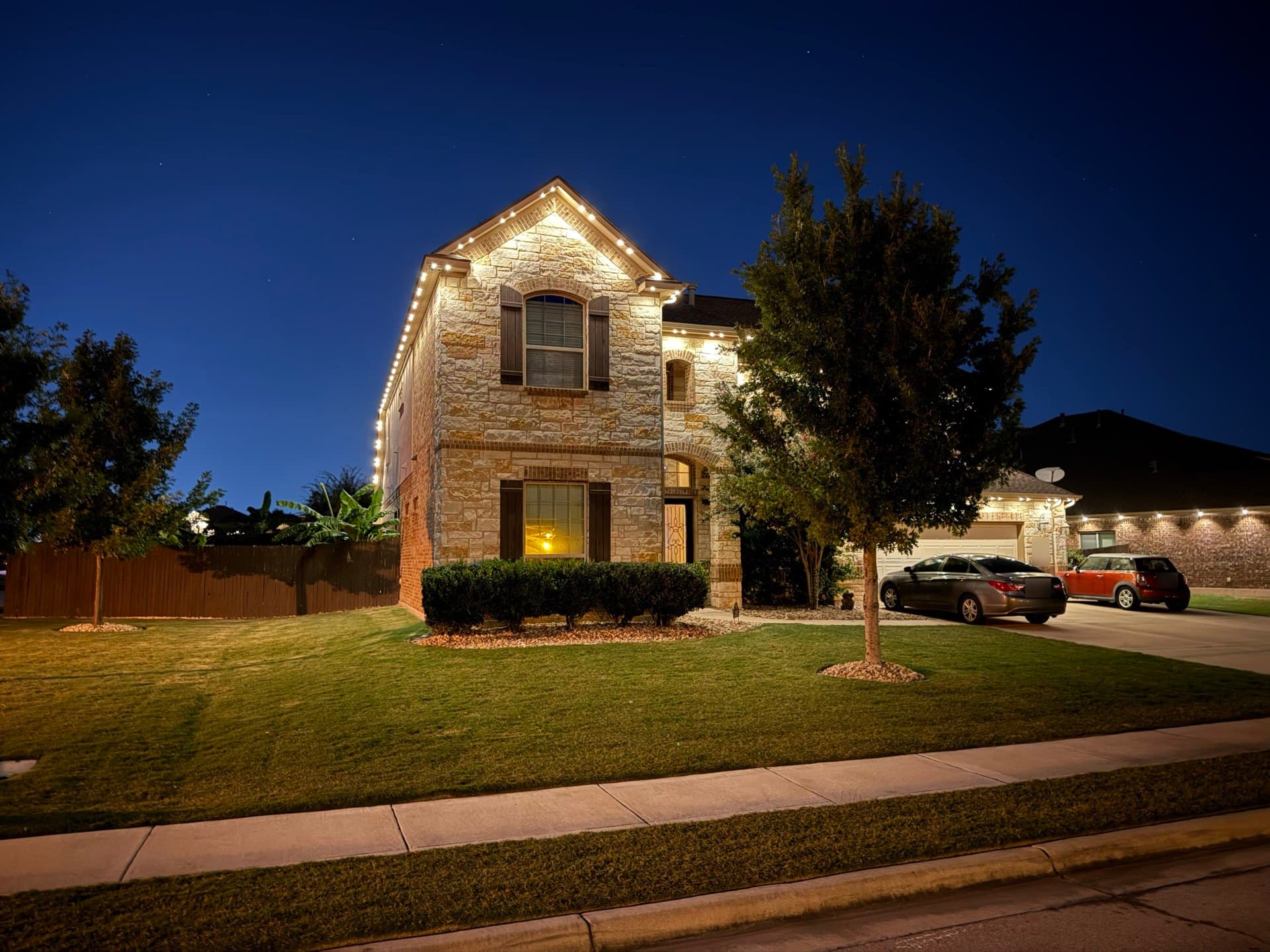
TruLight vs. Govee: DIY or Professional Lighting in Austin?
If you have priced permanent lighting at all, Govee is probably already on your list. The price is public and the kit ships to your door. That is a real option, and I am not going to pretend otherwise. I co-own TruLight Austin, so I have a financial interest in your choice. What I can do is lay out what Govee publishes about its own product, what a professionally installed system does differently, and which of those differences actually matter on an Austin roofline.
One thing to get straight before any of the numbers. Govee sells a lot of outdoor lighting, and the lines are not interchangeable. The product specifications below come from Govee's US page for Permanent Outdoor Lights Pro, models H706A/B/C, checked September 20, 2026. Govee also sells 2, 2 Pro and Prism models; Pro specifications do not describe all of them. If you are comparing a different Govee outdoor product, the specs change, and you need to read the page for the exact model in your cart rather than trusting a comparison written about a different one.
Compare the kit price with installed coverage
Start with the same elevations: front, sides, rear and any unlit gaps. Add the Govee kit, required accessories, any hired installation and later replacement labor to your budget. Compare that scope with an installed quote. Our TruLight installed price guide gives current budget ranges; it does not price a Govee kit or another installer's work.
What Govee publishes about the Pro
As of the date I accessed it, Govee's US Pro page lists IP67 string lights, an IP65 control box, and an adapter that is for indoor use only. It lists 75 scenes, a white range of 2700K to 6500K, Matter support, and a 200 foot maximum total length when the system is configured according to Govee's instructions. Govee sells the Pro as a retail kit. Its page specifies provided VHB glue and clips and allows cutting and extension within its instructions. You can do the work yourself or arrange installation separately; confirm the installer's labor and service terms. Anything else you want to compare, including lifespan figures, temperature ratings and warranty terms, should come from Govee in writing before you order rather than from a comparison article, mine included.
For comparison, TruLight is a professionally installed system. The lights sit in a color-matched aluminum track. It runs at 48V, each node holds six LEDs, three RGB and three dedicated warm white, and the published light rating is 100,000 hours. The longer feature by feature breakdown lives on our TruLight vs. Govee comparison page.
| Spec | TruLight | Govee Permanent Outdoor Lights Pro |
|---|---|---|
| Installation | Professional | Retail kit; DIY or separately arranged installation |
| Housing | Color-matched aluminum track | Confirm the housing material and finish options on Govee's current page |
| Voltage | 48V | 36V adapter listed on the Pro page |
| Emitters | 6 LEDs per node, 3 RGB + 3 warm white | 2700K to 6500K white range, 75 scenes (per Govee) |
| Ingress ratings | See our permanent lighting page | IP67 string lights, IP65 control box, indoor-use-only adapter (per Govee) |
| Published light rating | 100,000 hours | Confirm the current figure with Govee before ordering |
| Max total length | Designed and measured per home | 200 feet when configured per Govee's instructions |
| Warranty | See our warranty page | Get the current written warranty from Govee before ordering |
Manufacturers revise specs and warranty language whenever they want. Everything above was accurate on the sources listed at the bottom of this page on the date noted there. The document that actually protects you is the written warranty that comes with whatever you buy, not this page and not a product listing. Read it before you spend money.
Check the Pro's 200-foot system limit against your layout
Govee states a maximum total length of 200 feet for the Pro. That limit applies to the configured Pro system. A longer project may require multiple systems, so ask how their control and power arrangements will work before ordering.
Get measurements for everything you would want lit: the front elevation, each gable, the garage wing, the porch, the return along the side that the neighbors see. If your house is wide rather than tall, with several gables across the front and a garage set well off to one side, that elevation eats linear feet fast. Have the lighted sections, unlit gaps and distance to power identified separately. Check how each counts toward the manufacturer's configuration limits.
If the total is under 200 feet, the project may fit within Govee's published maximum. Total footage alone does not prove a workable configuration, so confirm the section lengths, the extension limits, and whether Govee's driver module is required for your run before you order. If the total comes in over, ask Govee how more than one system is meant to be run and controlled together, and where the second control box and second power source are supposed to live. Those are fair questions with real answers, and you want the answers before you buy, not while you are standing on a ladder. On a professionally installed system, the measuring and the layout are the installer's problem, and both should show up on the written quote before anyone touches your fascia.
What the house looks like with the lights off
Permanent lighting is off during the day. So most of the year you are not looking at light, you are looking at whatever holds the light. On limestone and light stucco, visible cable or mounting hardware may stand out against the exterior. Look from the street and from your driveway.
TruLight uses a color-matched aluminum track, so the channel picks up the trim color rather than standing off against it. Govee's product page will not tell you how the Pro looks against your particular trim color, so look. Before you commit either way, find a finished house and stand in front of it at noon, not at night. A nighttime photo does not tell you how the installation looks with the lights off. See a daylight example against similar trim.
Mounting deserves the same treatment. Ask how the product attaches, what the fasteners are, and how the line stays straight across a fascia board that is not perfectly straight to begin with. An older home or a custom build will rarely hand you a perfectly straight line to follow. That is where an installed system earns its cost and where DIY takes the most patience.
Heat, sun, and what a rating actually covers
A west facing wall in Austin in July absorbs direct sun all afternoon, and the fascia line sits right under a hot roof edge. Whatever you buy, ask the seller for the written temperature and weather ratings, and ask what each figure is measured against, because air temperature and surface temperature are not the same thing. A rating means something specific and you are entitled to know which measurement it describes before you spend the money. Put the same question to any installer bidding your job, including me.
While you are at it, read the exclusions in the written warranty that comes with whatever you buy. Exclusions are where two warranties differ far more than the headline year count does. Look for language about sun and heat damage, hail and weather events, pest damage, roof work, and what happens if the product is removed and reinstalled.
Who fixes it in year four
This is the difference that has nothing to do with specs. If you install a kit yourself, you also need a plan for diagnosis and replacement. Manufacturer support can help with the product; it does not automatically include someone coming to your home. If you hire an installer, find out whether that person also handles later repairs.
With an installed system, you make a phone call. Ask any installer, including me, exactly how that call goes: who performs warranty service, what a covered service call costs you, whether labor is covered separately from parts, how long that lasts, and whether the coverage transfers if you sell. Our current terms are on the warranty page and the system details are on our permanent lighting page. Ask Govee the same questions about the Pro, including what the written warranty covers, how a claim is filed, and who installs a replacement part.
That question is the decision. Both paths put light on a house. With an installed system, ask who handles service, what labor costs after the warranty period, and how long that support is promised in writing. With DIY, plan for your own replacement work or the cost of hiring it out. Include that responsibility in the decision.
Govee's permanent-lighting collection advertises three-year product coverage. Confirm the written terms for your exact model and seller. For TruLight, the lighting modules and control box carry a lifetime warranty: 100,000 hours for the lights, which is 11.4 years from installation, and five years for the control box. Parts and installation labor are covered for one year. Conditions and exclusions apply, and the signed agreement controls. A product term and a labor term answer different questions.
Sources
- Govee RGBICWW LED Permanent Outdoor Lights Pro product page (US), checked September 20, 2026: IP67 string lights, IP65 control box, indoor-use-only adapter, 75 scenes, 2700K to 6500K white range, Matter support, and a 200 foot maximum total length when configured according to Govee's instructions. These figures are attributed to this product only and do not describe other Govee product lines.
- Govee US permanent-lighting collection, checked September 20, 2026: current model lineup and advertised three-year product coverage. Confirm the written purchase terms.
- TruLight vs. Govee comparison and current manufacturer source links and TruLight warranty terms.
Related comparisons
Get a written quote
Request an estimate for the elevations you want lit. The site assessment confirms the measurements, mounting and track color so the written quote gives you a defined scope to compare.
Ready to Light Up Your Home?
Use our light preview tool to see your home in warm white, holiday colors, and more. Then get your free instant quote.
Get Your Free Quote Instantly