TruLight vs JellyFish Lighting: What Austin Homeowners Should Compare
I own the TruLight dealership in Austin, which means I sell one of the two systems in this article. Read it accordingly. My bias is obvious and I am not going to pretend otherwise. What I can control is the sourcing: every claim I make about JellyFish Lighting below comes from pages JellyFish publishes about its own product, linked at the bottom, and every claim I make about TruLight is limited to what we publish about ours. If you want the condensed side by side, the TruLight vs JellyFish comparison page covers the same ground in less space.
JellyFish is an established name in this category and a legitimate product, which makes this the harder kind of comparison: two real systems, and a decision that should not come down to whoever happens to be standing in your driveway.
Read the warranty as two numbers, not one
When a salesperson gives you a number of years, ask what that number actually covers.
On its security lighting page, JellyFish describes a five-year parts warranty and a one-year labor warranty. That is JellyFish describing JellyFish, and the same five-year parts and one-year labor structure appears on its own comparison article. Those are the published terms as of the date I accessed those pages, and they may have changed since. Confirm the current written terms with the local JellyFish dealer before you sign anything, and ask for them in the contract rather than from a web page.
That split matters most on rooflines that require a lift or difficult two-story access. A parts-only repair in years two through five is different from a repair that includes labor. Labor, trip charges, and lift fees can materially change what a repair costs, so ask both dealers to quote those charges for your roof height and put the numbers next to each other before you decide.
TruLight publishes its current terms at /warranty. I am deliberately not typing a number here, because terms get updated and the page is what governs. Read it, then read the JellyFish dealer's written terms, and compare them line by line rather than headline to headline.
A comparison table worth filling in yourself
Print this, take it to both bids, and make each rep fill in their own column in writing.
| What to compare | What JellyFish publishes about itself | What TruLight publishes about itself | What to confirm in writing |
|---|---|---|---|
| Parts coverage | Five-year parts warranty, per the JellyFish security lighting page | Current terms published at /warranty | Exact term, what counts as a covered part, and who pays freight |
| Labor coverage | One-year labor warranty, per the JellyFish security lighting page | Current terms published at /warranty | Hourly rate, trip charge and lift fees after the labor period ends |
| Control and integrations | Remote access, plus Alexa, Google and Control4 integrations, per JellyFish | App-based control through the installed controller | Which integrations are included versus sold separately, and what happens without internet |
| Diode architecture | Not published in the sources cited here | Six LEDs per RGBW node: three RGB plus three dedicated warm white | How warm white is produced, and whether you can see it in person after dark |
| System voltage | Not published in the sources cited here | 48V low voltage system | Voltage, wire gauge, and the actual run design for your roofline |
| Published light rating | Not published in the sources cited here | 100,000-hour light rating | What the rating measures and what the warranty actually covers |
| Track and finish | Confirm with the local dealer | Color-matched aluminum track, professionally installed | Finish match to your fascia or trim, and how corners and terminations are handled |
The blanks in the JellyFish column are honest blanks. Those specifications are not stated on the two pages I am citing, and I am not going to fill them in with guesses. Ask the dealer and get the answer on paper.
Run design is a drawing, not a slogan
You will hear voltage used as a shortcut in this category, usually in the form of a claim that a higher number means fewer power injection points. Do not accept that as a rule. How many injection points a run needs depends on wire gauge, the current and connected load on that run, the physical conductor distance, the controller limits, and the manufacturer's own published design rules for that product. Two systems at the same voltage can need very different designs.
Skip the debate and ask for the drawing. Have each bidder show you, before you sign:
- A roofline drawing with the planned run breaks marked on it
- Where each power supply and injection point will physically live
- The wire gauge being used and the load on each run
- Where the controller and transformer mount, and how they are protected from sun and rain
- How the design stays inside that manufacturer's published limits
Require every bidder, including me, to measure the house on site and hand you that run design with the quote. Comparing two drawings tells you more about the install you are going to get than comparing two spec sheets does.
What Austin exteriors do to the decision
Limestone and stucco change how white light reads
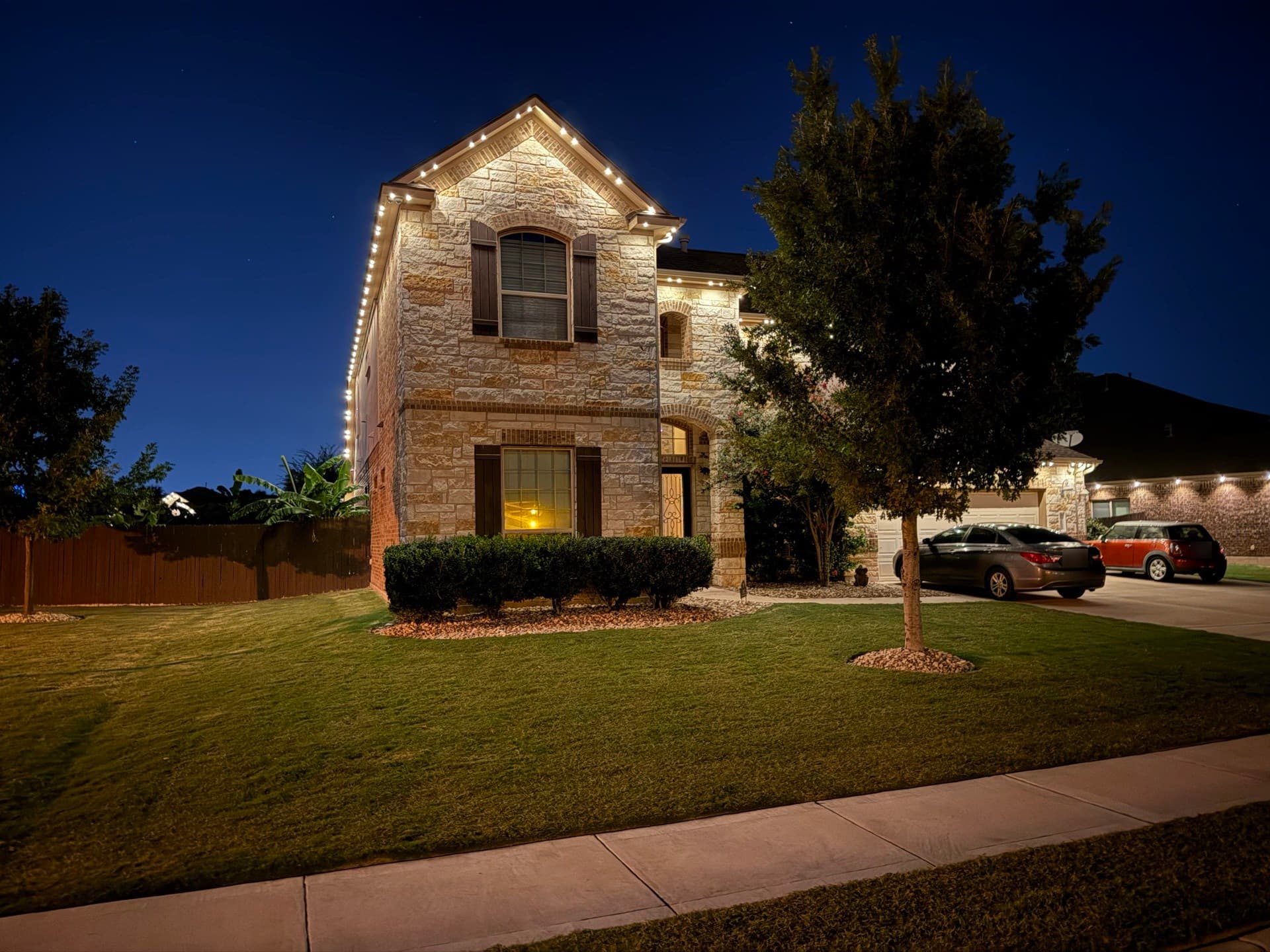
Limestone and stucco are warm, reflective surfaces, and Austin has a lot of both. Light that looks fine on a gray fiber cement wall can read yellow, green or washed out on cream limestone. This is where diode architecture stops being trivia. TruLight uses six LEDs per RGBW node, three RGB and three dedicated warm white, so warm white comes from dedicated white diodes rather than from mixing colored channels. Whether that matters to you is a judgment call you should make with your own eyes, on your own facade, after dark. Ask both companies for a demonstration on a comparable exterior at night, not a phone photo taken somewhere else.
Sun and heat are a mounting problem before they are a diode problem
Central Texas sun is hard on exterior hardware, and an LED-hour rating covers the diodes and not the track finish, the fasteners, or the exposed low-voltage runs on a south-facing elevation. TruLight installs color-matched aluminum track, which is part of why I care about how a track looks in daylight as much as how the lights look at night. Ask each bidder what the channel is made of, how it is finished, and what the warranty covers if the finish or the hardware fails. Then ask to see an installation that has been up for a few years.
Control, and the part people forget to ask about
JellyFish publishes remote access and integrations with Alexa, Google and Control4 on its security lighting page, and describes zoning, UL-listed components and remote operation in its own comparison article. Again, that is JellyFish describing its own product, and it is fair to take it at face value while still verifying it locally.
Integrations are genuinely useful. The follow-up question worth asking is what the system does when the integration is not available: no internet, an app update, a changed account. Ask both companies how the lights are operated in that situation and who you call when the app misbehaves three years from now. If your house sits well outside the service area a crew works out of, the answer to "who actually shows up" is worth more than the feature list.
How I would score the two bids
- Get both warranties in writing, and separate parts from labor on both.
- Price a realistic out-of-warranty service call at your own roof height, including lift or ladder work.
- Make each bidder produce the run design for your house.
- Look at both systems after dark on a warm-toned exterior, and look at both channels in daylight.
- Ask who performs the install, employees or subcontractors, and who performs the service later.
If you run that process all the way through and the other bid wins, it wins. I would rather lose a job to a well-informed comparison than win one because a homeowner never asked the second question. More on how we plan and install TruLight systems is on our permanent lighting page.
Sources
- JellyFish Lighting, security lighting solutions page, describing a five-year parts warranty, a one-year labor warranty, remote access, and Alexa, Google and Control4 integrations. Accessed August 10, 2026. jellyfishlighting.com/solutions/security-lighting
- JellyFish Lighting, "Everyone vs JellyFish" comparison article, in which JellyFish describes its own zoning, UL-listed components, remote operation, and the same five-year parts and one-year labor terms. Accessed August 10, 2026. jellyfishlighting.com/blog/everyone-vs-jellyfish
- TruLight warranty terms, current version: /warranty
Competitor information reflects the JellyFish pages cited above as they read on the access date. Confirm current written specifications and warranty terms with your local JellyFish dealer before deciding.
Related articles
Get a quote you can actually compare
If you want a bid that includes the run design, the written warranty terms, and a straight answer about what service costs after year one, request an estimate. Bring the other quote with you. I would rather walk through it with you than talk around it.
Ready to Light Up Your Home?
Use our light preview tool to see your home in warm white, holiday colors, and more. Then get your free instant quote.
Get Your Free Quote Instantly