
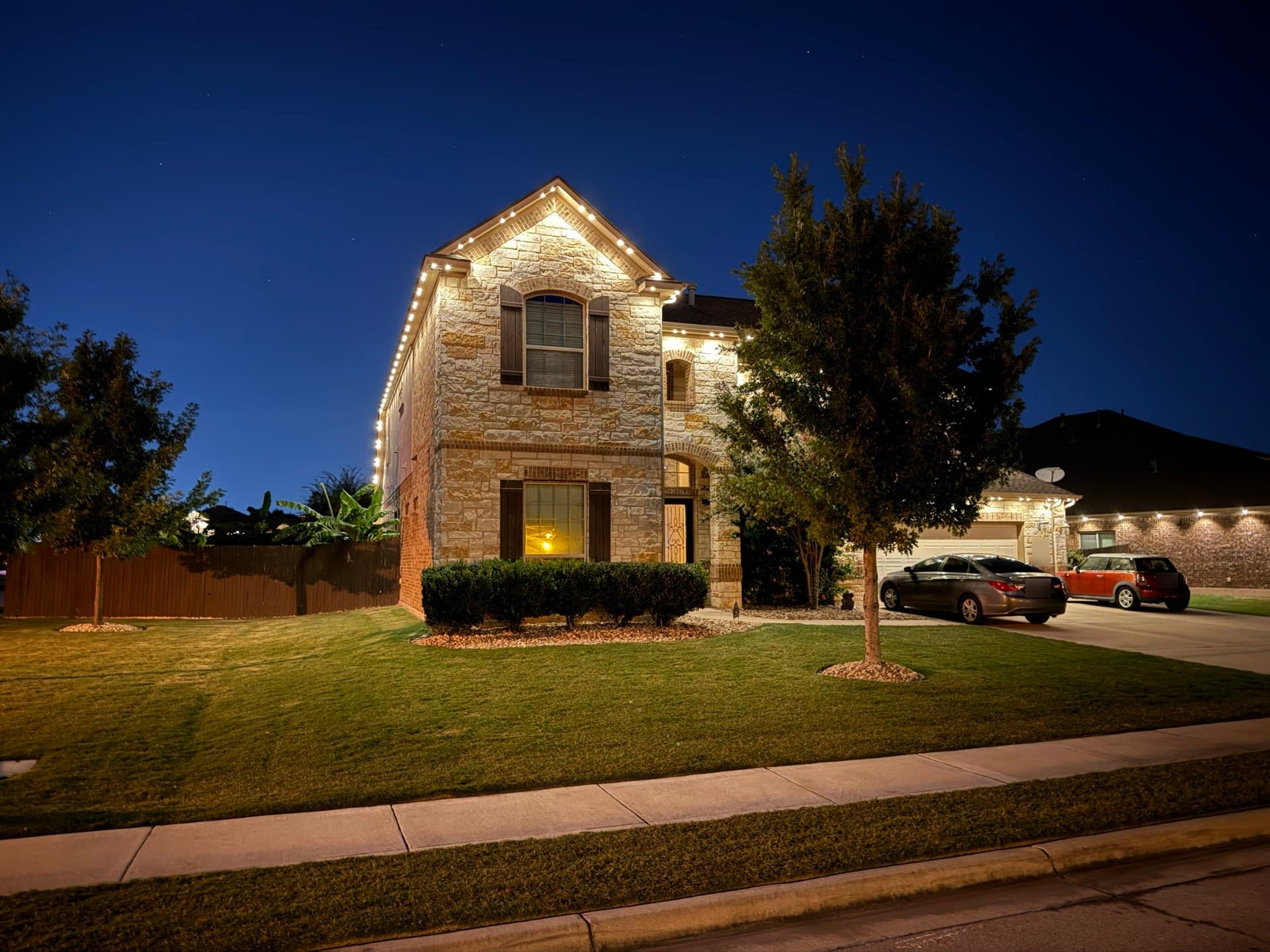
TruLight vs. Gemstone Lights: An Austin Homeowner's Guide
Gemstone Lights and TruLight both turn up on Austin permanent lighting shopping lists, and by the second or third quote the pitches start to blur together. I own the local TruLight dealership, so take my bias as read. What I can do is show you what Gemstone publishes about its own warranty, tell you what TruLight publishes about ours, and point at the handful of questions that change which system you should buy for your house. A fuller feature-by-feature breakdown lives on our TruLight vs. Gemstone comparison page.
One rule before any of it: the written documents your dealer hands you are what control, not this page and not what somebody said in your driveway. Ask both companies for the current quote and the current warranty on paper, and read them.
What Gemstone publishes about its warranty
Gemstone's warranty page, which I read on August 10, 2026, states the following. Coverage on the lights is labeled lifetime, and the same page defines that word as 50,000 hours based on the manufacturer's testing, so read the label and the definition together. Other products and parts carry 10 years. Coverage can be transferred one time within the 10-year period, and when the transfer happens within 90 days the new owner receives the remaining coverage up to a maximum of two years. Registration is required within 30 days. Gemstone states one year of labor.
Those are Gemstone's terms as Gemstone states them. I want to flag something specific about that page: older official Gemstone PDFs circulating online contain different language than the current page. If you are comparing warranties seriously, ask your Gemstone dealer for the current United States terms in writing, dated, and confirm that what they hand you matches what the company publishes today. Do that with any manufacturer whose documents have been revised, including mine.
On our side, TruLight runs a 48V low voltage system. Each RGBW node holds six LEDs, three RGB and three dedicated warm white. The published light rating is 100,000 hours. Our current warranty terms are on our warranty page, and the system itself is described on our permanent lighting page. Read ours the same way I am asking you to read theirs.
Transfer terms are a resale question
The headline number is where a warranty comparison usually stops. If you expect to sell the house before the coverage runs out, the transfer language matters more than the headline does.
Run the math on Gemstone's stated terms. The transfer is allowed one time inside the 10-year window. When it happens within 90 days, the new owner gets what is left of the coverage, capped at two years. So if you install this year and sell in year six, the buyer inherits up to two years under those stated terms, and only if the transfer paperwork moves inside 90 days of closing. If you sell again later, the one transfer is already spent.
Whether that matters depends entirely on your plan. If this is the house you retire in, transfer terms are close to irrelevant and you should spend your attention elsewhere. If you expect to sell inside a decade, ask both dealers the same three questions and get the answers in writing: how many times can this warranty transfer, how long does the new owner keep, and who files the transfer. Then look at your own timeline honestly. A homeowner who lists in year four has a very different warranty problem than one who does not.
Ask the same of us. Transfer language is easy to skip in a sales meeting and expensive to discover at closing.
Registration inside 30 days
Gemstone's page states registration is required within 30 days. Thirty days is short if your install lands in the middle of a build, a remodel, or a move.
So settle it before the crew leaves: who registers the system, the dealer or you? Get a copy of the confirmation. Put it with your closing documents rather than in an inbox you will search fruitlessly in year seven. If your dealer says they handle it, ask them to send proof when it is done. This is a small piece of paper that decides whether the rest of the warranty conversation was theoretical.
Power design on a long Austin roofline
Voltage sounds like installer trivia until you look at the shape of the house. A long single-story or low two-story elevation, a wide limestone or stucco face, a detached garage wing, and a lot of linear feet of eave all push the same direction. Put a house like that on a grade and the far end of the run sits a long way from the nearest power source.
All low voltage systems lose voltage over distance, which is why installers add power injection points on long runs. How many your house needs depends on total run length, the layout, and the system. TruLight is a 48V system, which is part of how we approach long runs. I am not going to tell you what Gemstone's system requires, because that is their engineering to state, not mine.
What I will tell you is what to ask both bidders, and to write down what they say. For my specific roofline, how many injection points does this design require, exactly where do they sit, where does the transformer mount, and does that appear on the quote? After measuring, they should be able to document the answer in the written design, because it affects what the soffit looks like and what a future service call costs.
Warm white and channel color
Warm white may matter more than holiday colors if you plan to use the system year-round, which makes the white output the spec worth studying before you sign. TruLight puts three dedicated warm white LEDs in every node alongside three RGB LEDs, so white comes off dedicated diodes rather than the color channels. Dedicated white and RGB-mixed white produce white differently. Ask your Gemstone dealer to explain how white is produced in their fixture and to show you a finished house running plain white after dark. Ask us the same. Photographs are lit and edited, so an evening spent driving past two finished houses beats any comparison table you will find online, including this one.
Then look at the track in daylight, which is when you see it most of the year. Against Austin limestone and pale stucco, an unmatched channel draws a line you will notice from the curb every afternoon. Ask both companies what colors the channel comes in, whether it can be matched to your fascia or trim, how it fastens, and what the channel and fasteners look like after several years of west-facing Texas sun. Then ask each warranty what it says about sun and heat damage. The exclusions do more to separate these documents than the headline numbers do.
The questions I would put to both of us
- Who performs warranty service, the manufacturer or the local dealer, and what does a covered service call cost me in trip or labor charges after the labor period ends?
- What is the labor coverage, how long does it run, and is it separate from parts?
- How many times can the warranty transfer, how much coverage does a buyer keep, and what is the deadline to file?
- Who registers the system and when do I get proof?
- What happens to coverage if a roofer removes a section of track?
- How long has this dealer worked in the Austin area, and can I see homes finished three years ago rather than last month?
Our side of those answers is on the warranty page. Get Gemstone's answers in writing too, and compare the documents rather than the sales meetings.
Sources
- Gemstone Lights warranty page, accessed August 10, 2026: coverage on the lights labeled lifetime, with that term defined on the same page as 50,000 hours by manufacturer testing; 10 years on other products and parts; one transfer permitted within the 10-year period, with the new owner receiving remaining coverage up to two years when the transfer occurs within 90 days; registration required within 30 days; one year labor. Older official Gemstone PDFs state different terms, so request the current United States warranty in writing from your dealer.
- TruLight warranty terms and TruLight permanent lighting: 48V low voltage system, six LEDs per RGBW node (three RGB plus three warm white), published 100,000 hour rating.
Related articles
- TruLight vs. Celebright: what Austin homeowners should compare
- TruLight vs. Jellyfish Lighting: an Austin homeowner's guide
- TruLight vs. Trimlight: what to compare on an Austin home
Get a written quote
Send us your roofline and we will put the design, the injection points, the channel color and the warranty terms in writing, so you have something solid to hold next to the other bid.
Ready to Light Up Your Home?
Use our light preview tool to see your home in warm white, holiday colors, and more. Then get your free instant quote.
Get Your Free Quote Instantly