
TruLight vs. Celebright: What Austin Homeowners Should Compare
If you are shopping permanent outdoor lighting in the Austin area, TruLight and Celebright will both end up on your list. They are two different systems built by two different companies, and the sales pitches sound similar until you read the spec sheets side by side. I own the local TruLight dealership, so I have an obvious bias. What follows is the honest version: what each system publishes about itself, what those numbers mean on a Hill Country roofline, and what I would ask before signing anything.
The published specs, side by side
Celebright's FAQ page states that its system runs on 24V, uses a compact 20mm frosted bulb, carries ETL listing 5023546, and rates its bulbs at 50,000 hours. The same page says 100 lights draw less energy than a single 60W bulb, and that the system works with Google Home, Amazon Alexa, and IFTTT.
TruLight runs on a 48V low voltage system. Each RGBW node holds six LEDs: three RGB and three dedicated warm white. The published light rating is 100,000 hours. You can see the full feature breakdown on our TruLight vs. Celebright comparison page.
| Spec | TruLight | Celebright |
|---|---|---|
| System voltage | 48V | 24V (per Celebright FAQ) |
| Light emitters | 6 LEDs per node, 3 RGB + 3 warm white | 20mm frosted bulb (per Celebright FAQ) |
| Published rating | 100,000 hours | 50,000 hours (per Celebright FAQ) |
| Warranty | See our warranty page | 10 years, transferable, for systems bought on or after Jan 1, 2025 (per Celebright) |
Manufacturers revise specs and warranty language, so treat every table like this one as dated. Everything above was accurate on the sources listed at the bottom of this page as of August 10, 2026. The version that protects you is the written quote and the written warranty the local dealer hands you. Ask for both on paper, from both companies.
Voltage is one input to the design
Voltage sounds like an installer detail, and it does belong in the conversation, but it is one input among several. Conductors create voltage drop and dissipate some power, with the result depending on current, resistance, and distance. That means the wire gauge, the load the run draws, the length of the run, the controller and connectors in use, and the limits the manufacturer sets for its own hardware all shape the answer. The system voltage is one term in that arithmetic. Neither 48V nor 24V tells you by itself how a specific house will be powered.
That arithmetic gets less abstract on a long, low house with wide limestone or stucco elevations and a lot of linear feet of eave. Put one on a slope, with the garage wing a long way from the nearest outlet, and the distances start doing real work. The number of power injection points and where they land comes out of the design: gauge, load, run length, controller, connectors and manufacturer limits together. Nobody can hand you that number off a spec sheet, and any bidder quoting it before measuring is guessing.
So put the same question to both bidders in the same words: show me the power and injection layout for my house. How many injection points, where do they sit, where does the transformer mount, and what wire is being run? Require both of them to measure the roofline first and to put that finished design on the written quote.
Warm white is the spec worth studying
If you expect to use the system for everyday warm white as well as holidays, inspect that setting closely before you buy.
TruLight puts three dedicated warm white LEDs in every node alongside the three RGB LEDs. Dedicated white diodes and RGB-mixed white produce white differently, so compare both systems on similar exterior materials after dark. Celebright describes its emitter as a compact 20mm frosted bulb and rates it at 50,000 hours. If you are comparing the two, ask each dealer the same direct question: how is white produced in this fixture, and can I see it running on a real house after dark before I buy?
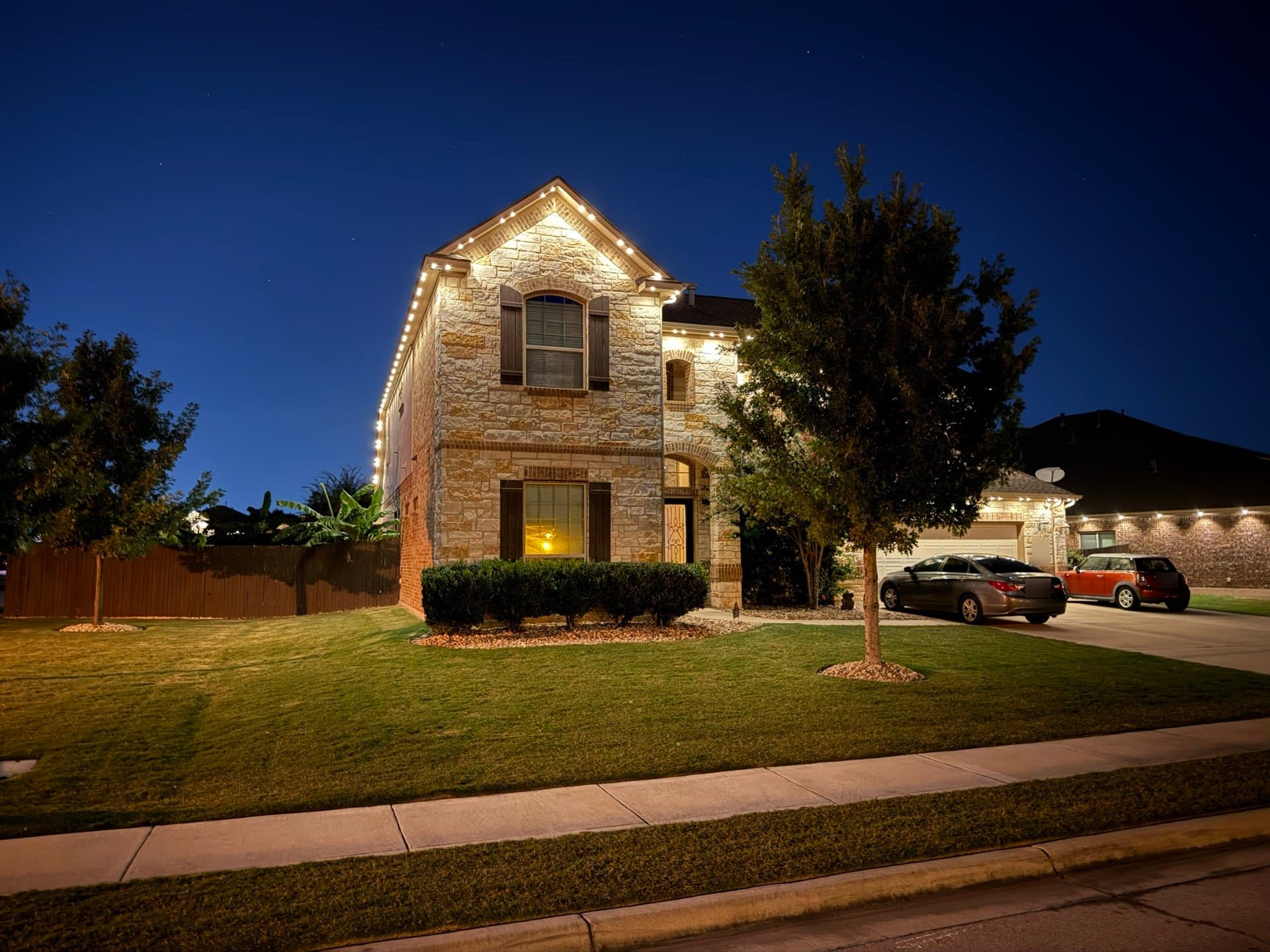
Photos are lit and edited, so drive by two finished homes at night, one of each brand, and look at the white. That one evening will tell you more than any spec table, this one included.
What the Austin sun does to a track you will look at every day
Most of the year the lights are off during the day and you are still looking at the channel. On limestone and light stucco, a track that does not match reads as a dark line across the whole front of the house. Ask both dealers what colors the channel comes in, whether it can be color matched to your fascia or trim, and how it is fastened. Then ask what the fasteners and the channel look like after several years of direct west-facing Texas sun.
Heat and UV also belong in the warranty conversation. Ask both companies, in writing, what the upper operating temperature is and what ingress protection rating applies to the exact parts you are buying. Then read the exclusions section of each warranty for language about weather events, hail, sun damage, roof work, and pest damage. Exclusions are where warranties differ far more than the headline number does.
The dealer is half of what you are buying
Both systems are installed by local dealers, and the dealer is who you will call when a section goes dark in year four. So ask both:
- Who performs warranty service, the manufacturer or the local dealer, and what does the local dealer charge for a service call that the warranty covers?
- What is covered by labor, for how long, and is that separate from the parts warranty?
- Is the warranty transferable if I sell the house, and what does the buyer have to do to keep it?
- How long has this dealer operated in the Austin area, and can I see homes finished two or three years ago rather than last month?
- What happens to my warranty if a roofer removes a section of track?
Celebright's warranty page states a 10-year component warranty that is transferable to a new homeowner for systems purchased on or after January 1, 2025, and notes that older purchases keep the previous 5-year non-transferable terms. Our current terms are on our warranty page, and details on the system itself are on our permanent lighting page. Put both documents on the kitchen table and read the exclusions before you compare the headline years.
If you want a written quote from us to compare against, that is what we are here for. Get two quotes, read both warranties, look at both systems after dark, and then decide.
Sources
- Celebright FAQ, accessed August 10, 2026: 24V system, 20mm frosted bulb, ETL listing 5023546, 50,000 hour bulb rating, energy comparison, Google Home, Amazon Alexa and IFTTT support.
- Celebright warranty, accessed August 10, 2026: 10-year transferable component warranty effective January 1, 2025; prior 5-year non-transferable terms for earlier purchases.
- TruLight vs. Celebright comparison and TruLight warranty terms.
Published specifications and warranty terms change without notice, including ours. Ask each company for the current written documents that apply to the exact product you are buying before you sign.
Related articles
- TruLight vs. Bosso: what Austin homeowners need to know
- Is 48 volt permanent outdoor lighting safe? The Austin engineering breakdown
- RGB vs. RGBW permanent outdoor lighting: which is better for Austin homes
Get a written quote
Tell us about your roofline and we will put the design, the injection points, the channel color and the warranty terms in writing so you have something real to compare.
Ready to Light Up Your Home?
Use our light preview tool to see your home in warm white, holiday colors, and more. Then get your free instant quote.
Get Your Free Quote Instantly