
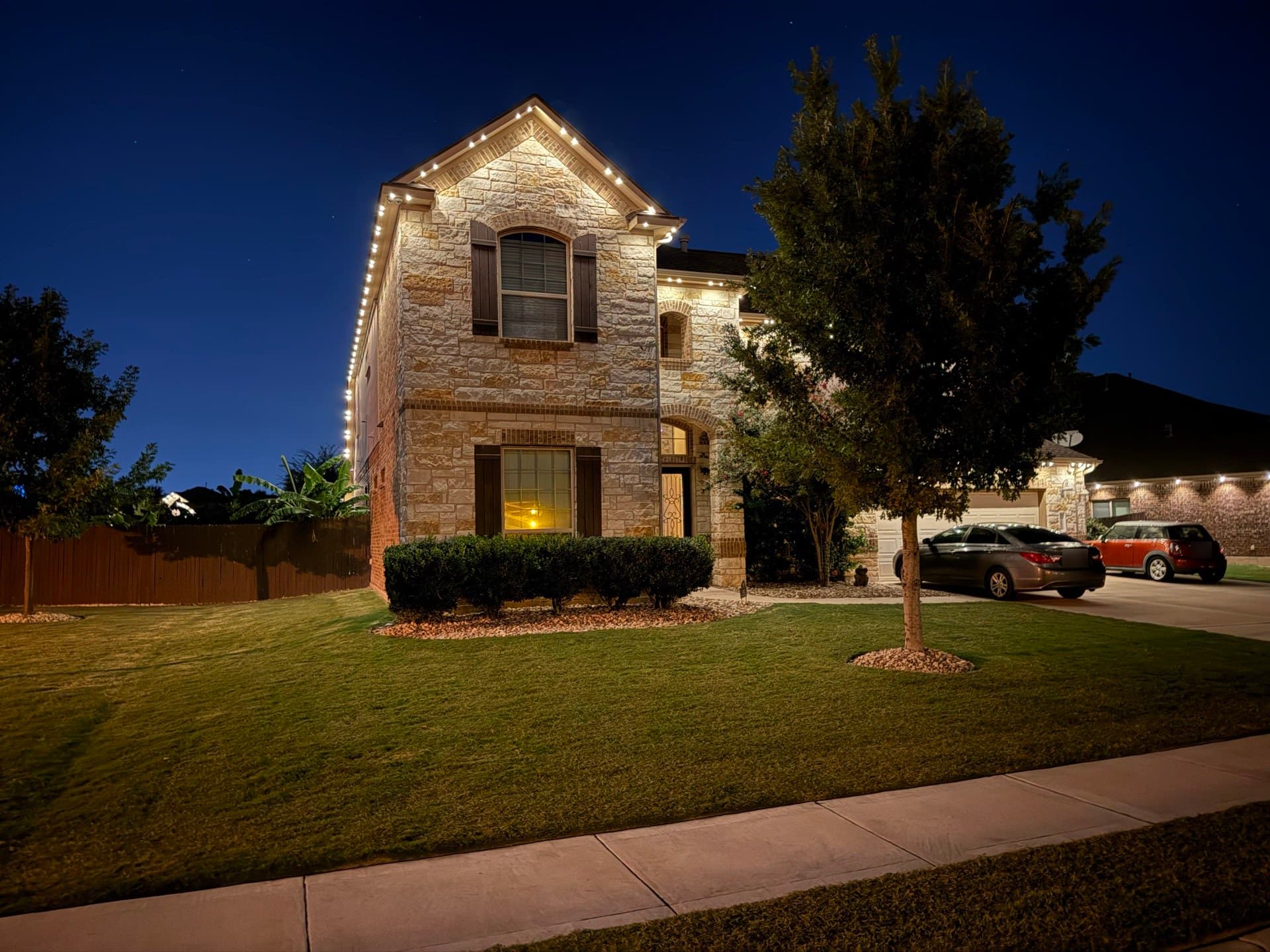
TruLight vs EverLights: What Austin Homeowners Should Compare
Before anything else: I own the TruLight dealership that serves the Austin market. I make money when a homeowner picks TruLight, so treat this the way you would treat a comparison written by a competitor, because that is what it is. What I can do is show you exactly where each published claim comes from, link the manufacturer pages so you can check them yourself, and be honest about the places where the public documentation does not answer the question. If you want the condensed side by side version, it lives on our TruLight vs EverLights comparison page.
Why this comparison plays out differently in Austin
Three local conditions do most of the work here: long single plane rooflines with deep overhangs, limestone and stucco exteriors, and sun exposure on a west facing fascia in July. That last one is the main environmental load on the product. What decides your quote, though, is the measured length and shape of your own elevations, not the neighborhood printed at the top of the estimate.
Those conditions change what matters in the decision. Long runs turn electrical planning into an engineering question rather than a spec sheet question. Limestone and stucco make the daytime appearance of the track a bigger deal than it is on dark siding. Strong UV and heat make the warranty exclusions worth reading before the warranty length.
Rated hours and warranty years are two different numbers
EverLights' installation FAQ page states that EverLights are rated for 50,000 hours. TruLight publishes a 100,000 hour light rating. Both of those are manufacturer published figures, and neither one is a promise about your specific roofline.
A published hour rating describes the light source under whatever conditions and measurement method the manufacturer used. It is not the same thing as a warranty, and it does not cover the controller, the transformer, the wire, the connectors, or the track. When a dealer quotes you an hour figure, ask what that number refers to, how it was measured, and which components it applies to. Ask me that too.
The EverLights warranty question I would ask first
EverLights' installation FAQ page describes color changing EverLights as carrying a one year product warranty, raised to five years when installed by EverLights, with one year of labor, and describes EverLights Classic as carrying a 15 year light warranty. Those are FAQ summary terms. EverLights' current official warranty page describes a different and more detailed structure: coverage varying from one to ten years depending on product and installation method, coverage that applies to the product rather than installation labor, separate terms for different components, and schedules that differ by installation date.
I am not calling that a contradiction, and I would not want anyone summarizing my warranty in one line either. It means the applicable terms are product specific and date specific. The only thing that matters to you is the written schedule that applies to the exact product you are buying, installed the way you are having it installed, on the date you are having it installed.
The mechanics in the official warranty are worth reading closely
- EverLights' warranty page states that claims must be filed within 30 days after discovering a problem. That is a short window if a section fails while you are traveling.
- It states that transfer requires original registration within 90 days, which matters if you may sell the house.
- It states that coverage applies to product rather than installation labor.
- It lists exclusions including sun or UV fading and discoloration, roof, gutter or soffit failure, wind, improper installation, and power flow issues.
That UV and sun fading exclusion is the one I would sit with if I lived on a west facing elevation in Central Texas. I am not claiming any product fades or does not fade, because I have not run comparative testing and I am not going to invent results. I am saying that in a market with this much sun, you should know in advance which appearance changes are covered and which are excluded, in writing, from whoever you buy from. Our current terms are published at /warranty. Read them rather than take my word for it.
Published specifications side by side
| Item | TruLight (published) | EverLights (per its own pages) |
|---|---|---|
| Published light rating | 100,000 hours | Rated for 50,000 hours per the EverLights installation FAQ page |
| Warranty structure | Current terms published at /warranty | Warranty page states coverage varies from one to ten years by product and installation method, covers product rather than installation labor, with separate component terms and schedules that differ by installation date |
| Claim and transfer mechanics | See current terms at /warranty | Warranty page states claims must be filed within 30 days of discovering a problem and transfer requires original registration within 90 days |
| Node construction | Six LEDs per RGBW node: three RGB plus three dedicated warm white | Not stated on the pages cited here; ask for written specifications |
| Track and color matching | Professionally installed color-matched aluminum track | EverLights' residential page describes professional installation and 25 color-matching channel options |
| System voltage | 48V low voltage system | Not stated on the pages cited here; ask for written specifications |
Everything in the right column is attributed to EverLights' own published pages, linked in the Sources section. Manufacturers update pages, so confirm the current written specifications and warranty directly with the company or its local dealer before you sign anything.
How the system makes white light, and why that shows up on limestone
TruLight uses six LEDs per RGBW node, three RGB plus three dedicated warm white. That is a hardware description, not a claim that everyone else looks bad. If you expect to use warm white often, ask every dealer how the fixture produces it.
Limestone and light stucco reflect warm tones differently than dark brick or fiber cement. A white that reads clean on a dark elevation can read differently on a pale limestone face. If white light will be one of your main settings, ask each company to show you their warm white on a house with a similar exterior material, at night, in person. Do not decide this from a phone screen or a rendered image, whoever produced it.
Long Hill Country rooflines are a design problem
TruLight is a 48V low voltage system, and this is where comparison shopping usually goes sideways. Voltage by itself does not determine safety, maximum run length, brightness, how many power injection points a run needs, efficiency, build quality, or code compliance. What determines those things is the complete listed or specified system taken together, the wire gauge and conductor design, the connectors, the controller and power supply, the manufacturer's published limits, and the installation design for your specific elevations. A wide single story elevation and a compact two story can use the same product and still need different run and injection layouts.
So when you are comparing quotes, compare the designs:
- Ask each company to explain how they determined run lengths and injection points for your house, in writing.
- Ask what the manufacturer's published limits are for the exact configuration being quoted.
- Ask what happens electrically at the longest run on your elevation, and who is responsible if brightness or color is inconsistent along it.
- Ask how the transformer and controller are mounted, protected, and serviced.
Daytime appearance and track color
EverLights' residential page describes professional installation and 25 color-matching channel options. TruLight professionally installs color-matched aluminum track.
The practical question is how the track terminates and transitions on your house: at the corners, at the returns, where fascia meets stone, and where the roofline steps. How many colors exist in a catalog matters much less than that. On limestone and stucco elevations with deep shadow lines, those transitions are what you see from the driveway. Ask to see a completed install in daylight, not just at night, from whoever you are considering.
If reading both sets of documents leads you to EverLights, that is a legitimate outcome and I would rather you buy the right thing than buy from me. I am confident enough in what we install to tell you to check my claims as hard as you check theirs.
Sources
- EverLights permanent Christmas light installation FAQ, source of the 50,000 hour rating and the FAQ summary warranty terms cited above.
- EverLights official warranty page, source of the one to ten year range, product versus labor coverage, component specific terms, install date dependence, 30 day claim window, 90 day transfer registration, and listed exclusions.
- EverLights residential page, source of the professional installation description and 25 color-matching channel options.
- TruLight current warranty terms: /warranty. TruLight system details: /services/permanent-lighting.
Published pages change. Confirm current written specifications and warranty terms with each company before purchase.
Related articles
- TruLight vs Trimlight for Austin homeowners
- TruLight vs JellyFish Lighting for Austin homeowners
- TruLight vs EverLights comparison page
Get a real number for your house
If you want a quote that includes the written design for your run lengths and injection points, the exact product specifications, and our current warranty terms rather than a per foot guess, request an estimate at /estimate. Bring the EverLights documents with you and make me answer the same questions I told you to ask them.
Ready to Light Up Your Home?
Use our light preview tool to see your home in warm white, holiday colors, and more. Then get your free instant quote.
Get Your Free Quote Instantly