TruLight vs Generic DIY Permanent Lights: What Austin Homeowners Need to Know
Before anything else: I own the TruLight dealership here in the Austin area. I sell and install this product, so I have an obvious financial interest in what you decide. Verify every competitor detail yourself against the manufacturer's own pages, which I have linked. What I can offer that a review site cannot is the installer's side of it, which is standing on a ladder above a limestone elevation in July trying to make a light line look like it belongs there.
This is a process comparison, not an argument that every do-it-yourself permanent lighting product is bad. Some are well built. The difference is rarely a single spec on a box. It is who owns each of the roughly twelve decisions that turn a box of parts into a finished exterior. For the head to head product breakdown, see our TruLight vs generic permanent lights comparison page.
What "DIY" actually means in this category
DIY in this category covers a wide range, from consumer kits designed for a homeowner with a ladder and a Saturday to contractor-grade hardware a determined homeowner can buy through a reseller. Those are not the same purchase and they do not carry the same risk.
To keep this concrete, one published example. Govee's United States product page for its RGBICWW LED Permanent Outdoor Lights describes a do-it-yourself installation, IP67 string lights, an IP65 control box, an adapter for indoor use only, 75 scenes, a 2700K to 6500K white range, Matter, Alexa and Google Assistant compatibility, and a maximum of 200 feet when the system is configured according to Govee's instructions. Those are that product's specifics as Govee publishes them for the US market, not facts about DIY products as a category. Operating temperature range, rated hours and warranty length are not quoted here because I did not confirm them on that page. If those matter to you, get them from Govee's current US documentation for the exact model in your cart rather than from a page written for another market.
That distinction matters. Several claims get made about DIY lighting that do not hold across the board: that they all use adhesive backing, that none have a track, that they all fail in Texas heat, that none can be serviced. Some products fit some of those descriptions. Plenty do not. Look up the exact model you are considering on the manufacturer's own site and read the current written specification and warranty rather than a summary someone wrote two years ago.
What we publish about our own system
For symmetry, here is what TruLight publishes: a 48V low voltage system, six LEDs per RGBW node, three RGB plus three dedicated warm white, a published 100,000-hour light rating, and a professionally installed color-matched aluminum track. Current warranty terms are at /warranty.
I will not tell you that 48V by itself means safer, brighter, longer runs, fewer power injection points, more efficient, better quality, or code compliant. Those outcomes depend on the complete listed or specified system and on how the installation is designed for your particular house. Anyone who leads with a voltage number as if it settles the argument is selling a shortcut, and that includes anyone selling my product.
The twelve decisions, and who makes them
Hiring us assigns the installation decisions and responsibilities described in the written contract. When you DIY, you keep all of them, and some homeowners genuinely want to.
| Decision | DIY: you own it | Professional install: we own it |
|---|---|---|
| Scope definition | You decide which rooflines get lit, and you find out mid-project if you measured short. | We measure the elevations and quote a defined scope in writing before anything is ordered. |
| Roof access | Your ladder, your pitch, your fall risk, your insurance question. | Our crew and equipment; ask us for current proof of insurance and the written project scope. |
| Mounting plan | You determine fastener type and spacing for your specific fascia, drip edge or soffit. | We design the track layout and fastening for the substrate we find on site. |
| Daytime appearance | Whatever the product looks like unlit on your trim is what you get. | Color-matched aluminum track, planned so the line reads as part of the elevation. |
| Electrical and controller placement | You choose the outlet, the routing and the enclosure location. | Supply location, run routing and controller placement are part of the design. |
| App and account ownership | Yours entirely, including future app or platform changes. | Yours to use, with us as the first call when something behaves oddly. |
| Written warranty | Product warranty from the manufacturer, per that model's published terms. | Product terms at /warranty, plus a named local party accountable for the installation. |
| Labor responsibility | Your time, repeated on every future service visit. | Included in the installed price. |
| Future roof work | You coordinate removal and reinstallation with your roofer. | Coordinated as a service call rather than a homeowner project. |
| Repair access | Back on the ladder, at whatever height the failure happened to occur. | A scheduled visit. |
| Total owner time | Install weekend plus every future intervention. | The estimate, installation access, and any later service coordination. |
| Who is accountable when it goes wrong | You are, to yourself. | The contract and warranty should state who is responsible for installation defects and later service. |
Why this weighs differently in Central Texas
Roofline geometry
A house is rarely a simple rectangle. Wide elevations, long single runs, stepped gables, deep overhangs and planes at different heights all change the job. That geometry drives how much linear footage you need, how the run is laid out and supplied, and how hard the install is to reach, and none of it shows up until somebody measures.
The published maximum coverage figure on any product page, including the 200 feet Govee lists for the product above, is a capability statement subject to the manufacturer's own configuration instructions. It says nothing about whether your house works in one run. A front elevation that eats most of a kit's rated length is a different project than one where the kit covers three sides. Measure before you assume, and design inside the published limit rather than against it.
Sun, heat and materials
Central Texas UV and summer heat are real loads on anything mounted outdoors. I will not tell you that heat kills DIY products and spares professional ones, because I cannot support that. Published operating ranges and ratings are the right thing to read, and the manufacturer's current page for your market and your exact model is the right place to read them. TruLight publishes a 100,000-hour light rating. Ask whoever is selling you a DIY kit for the equivalent figures in writing. Do not treat two manufacturers' numbers as directly comparable, though, because the testing methods and definitions behind them differ, and neither one predicts what your specific house will experience.
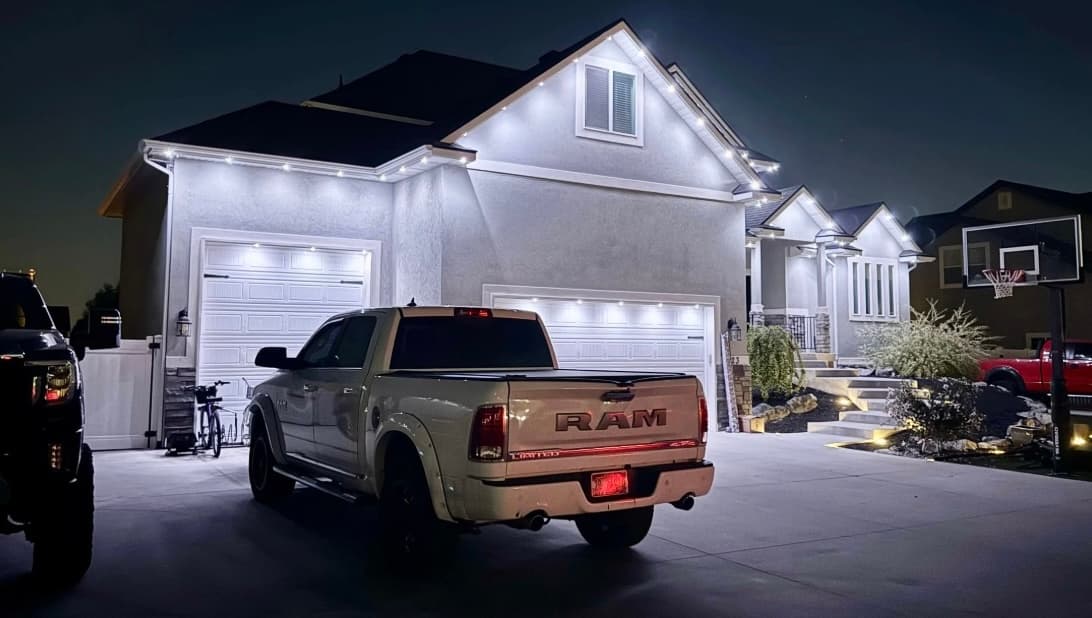
Appearance is the other material question. Limestone and stucco elevations are unforgiving in daylight because they are bright, textured and often light-colored. Anything mounted along the fascia is visible against them at noon, not just at night. The daytime line matters as much to me as the nighttime one, and it is worth seeing any product you are considering in daylight, on a real house, before you commit.
Questions to ask before you decide either way
- What is the exact model number, and what does the manufacturer's current page say about its rating, operating range, ingress protection and maximum run?
- What does the written warranty cover, for how long, and what voids it?
- If a single node fails in year four at the highest point of the roof, who fixes it and how?
- When the roof gets replaced, who removes and reinstalls the system, and at what cost?
- Does the mounting method suit my specific fascia, drip edge or soffit, or am I assuming?
- Where does the controller live, what is it rated for, and can I live with that location?
- How many hours of my own time am I signing up for, including future service?
If your answers point toward DIY, that is a defensible outcome. Some people like the project, have the access, and would rather own the whole thing. My argument is narrower than always hire someone. It is that the install decides most of the long-term satisfaction or regret, and that the call should be deliberate rather than default.
Sources
- Govee RGBICWW LED Permanent Outdoor Lights product page (United States), reviewed August 10, 2026, for the do-it-yourself installation description, IP67 string lights, IP65 control box, indoor-use-only adapter, 75 scenes, 2700K to 6500K white range, Matter, Alexa and Google Assistant compatibility, and a 200 foot maximum when configured according to Govee's instructions. Operating temperature range, rated hours and warranty length are not asserted here because they were not confirmed on this page, and they apply to this product only rather than to other Govee lines. us.govee.com
- TruLight system specifications and current warranty terms: /services/permanent-lighting and /warranty
Specifications and warranty terms change without notice. Confirm the current written specification and warranty directly with the manufacturer or dealer before you buy, whichever product you choose.
Related articles
Get a written estimate
If you want a defined scope for your specific elevations rather than a guess at linear footage, request an estimate. We will measure, put the scope in writing, and give you the current written warranty terms to read before you decide. If you come away thinking DIY fits your house better, you will at least be making that call with real numbers.
Ready to Light Up Your Home?
Use our light preview tool to see your home in warm white, holiday colors, and more. Then get your free instant quote.
Get Your Free Quote Instantly